Vol. 9 No. 2 (2025): Jurnal Ilmu Perilaku
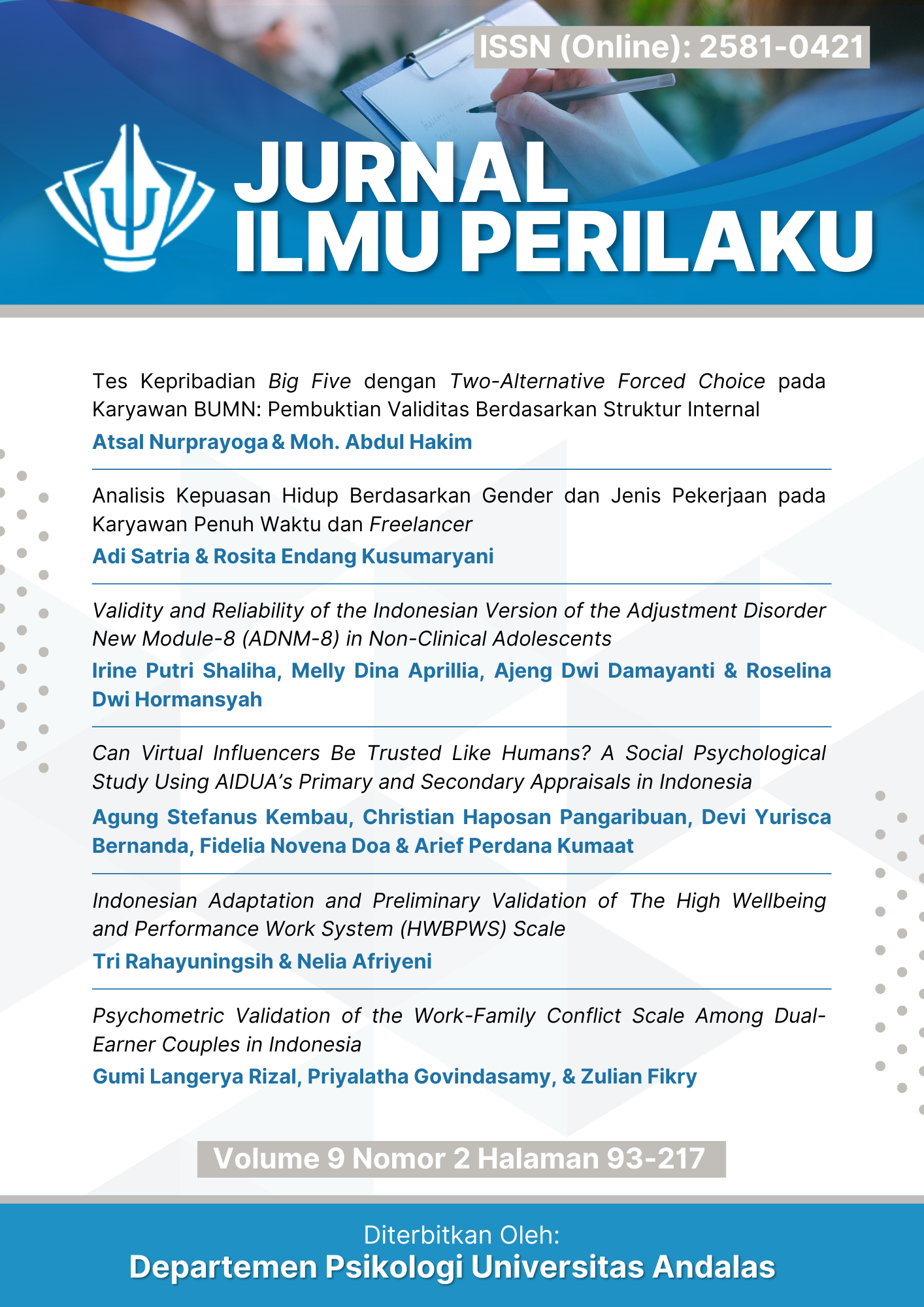
In this volume, we are delighted to present a diverse array of articles that span an expansive spectrum of psychological inquiry. As always, our goal remains to foster an environment where scholarly exploration thrives, generating insights that contribute to local and global understandings of human behavior and experience. This new edition comprises six articles, each offering valuable contributions to the field of psychology. We extend our heartfelt appreciation to the diligent researchers whose dedication has enriched this edition with thought-provoking findings and discussions.
The first article examines the validity evidence for the Big Five Personality test based on its internal structure, using confirmatory factor analysis (CFA). Results indicated that the test demonstrated good internal structural validity, as evidenced by acceptable model fit across all dimensions based on the Chi-square, SRMR, RMSEA, CFI, and TLI indices. These findings provide a foundation for the company to validate the test's use, though regular evaluation is recommended to maintain its relevance and accuracy in workplace applications. The second article explored differences in life satisfaction between full-time employees and freelancers, as well as the role of gender in influencing these differences. The results indicate no significant difference in life satisfaction between employment types, suggesting that flexibility provides benefits across both groups. However, female workers reported higher life satisfaction, supported by their ability to manage work–life balance and stronger social support.
The third article evaluates the reliability and construct validity of the Indonesian version of the Adjustment Disorder New Module-8 (ADNM-8) as a screening tool for adolescents. The psychometric evaluation included internal consistency analysis using Cronbach's alpha and confirmatory factor analysis (CFA) with the DWLS estimator to accommodate ordinal data. Indonesian ADNM-8 demonstrated strong internal consistency. These findings support the Indonesian ADNM-8 as a reliable and valid screening instrument for AjD in adolescent populations. Furthermore, the fourth article isolates primary (cognitive) and secondary (affective) appraisals to explain why users of the Artificial Intelligence Device embrace—or recoil from— synthetic personae using the Artificial Intelligence Device Use Acceptance (AIDUA) model. The result showed social influence and hedonic motivation jointly explained 45% of performance expectancy, while anthropomorphism increased effort expectancy, that is, ease of use. These results uncover "utilitarian collectivism," a dual cognitive–affective engine wherein peer validation and hedonic thrill sustain utilitarian value, and position anthropomorphism as a usability heuristic rather than a mere novelty cues.
The fifth article describes the adaptation and validation of the High Wellbeing and Performance Work System (HWBPWS) scale for the Indonesian workforce. The evaluation of the measurement model included testing for convergent validity, internal reliability, and discriminant validity. The results showed that the Indonesian version of the HWBPWS retained 40 fit items across 10 dimensions, with three dimensions removed due to low reliability. These findings also showed that all constructs achieved acceptable validity and reliability. Lastly, the sixth and final article is also about adapting the psychological scale. This study validates the bidimensional WFC scale, Work Interference with Family (WIF), and Family Interference with Work (FIW), among dualearner spouses in Indonesia. The results confirmed strong internal reliability and adequate convergent validity, supporting a stable two-factor structure in which WIF and FIW emerged as related but distinct constructs. The findings highlight culturally embedded and gendered dynamics of role conflict in Indonesian couples and contribute to cross-cultural work–family research.
The entire Editorial Board of Jurnal Ilmu Perilaku (JIP) would like to express our gratitude to all partners who have taken the time to help us. Through their willingness and volunteerism to review the manuscript, JIP continues to publish and evolve as a platform for intellectual growth. To all readers, we hope our published articles can provide valuable new insights and inspiration. May the knowledge shared within these pages stimulate dialogue, inspire new avenues of research, and contribute to the ongoing advancement of psychological science. In addition, we invite all readers to submit their best manuscripts to our journal. We hope that our small endeavor can benefit and contribute to the development of psychology in Indonesia. Please enjoy the read!
Greetings,
Editorial Board of JIP
Published:
2026-02-25