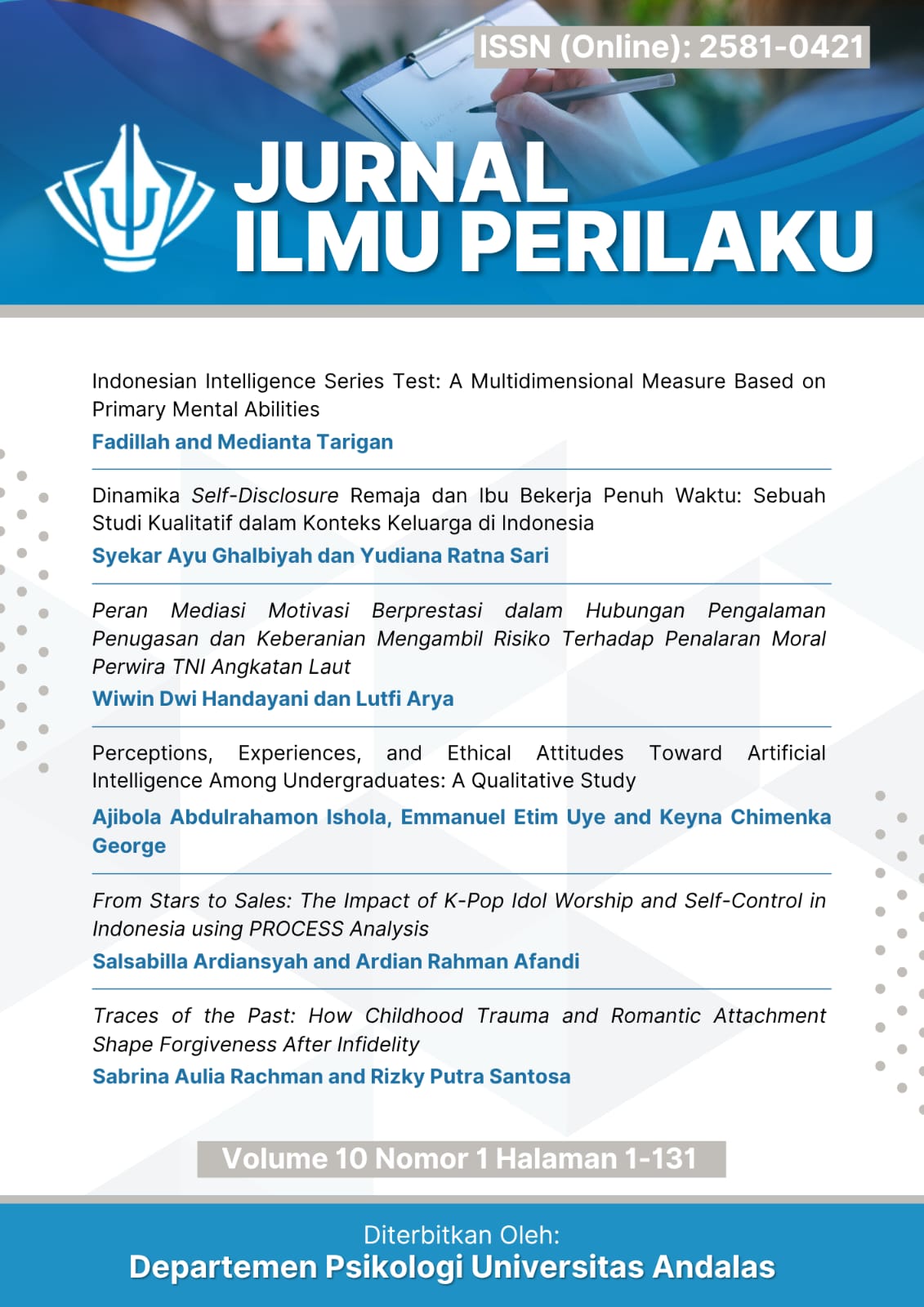
Perceptions, Experiences, And Ethical Attitudes Toward Artificial Intelligence Among Undergraduates: A Qualitative Study
DOI:
https://doi.org/10.25077/jip.10.1.67-96.2026Keywords:
artificial intelligence, ethical attitudes, experience, perceptions, undergraduatesAbstract
The rapid integration of generative artificial intelligence (AI) into Nigerian higher education has transformed how students learn, complete assessments, and conceptualize knowledge. Yet while quantitative studies have documented Nigerian students' favorable perceptions and growing use of AI tools, qualitative understanding of how undergraduates in this context perceive, experience, and ethically evaluate these technologies remains less developed. This qualitative study explored the perceptions, usage patterns, educational impacts, ethical attitudes, and future projections regarding AI among 15 undergraduates at the University of Ibadan, Nigeria. Participants aged 19 to 31 years were purposively recruited from six academic departments: Psychology, Computer Science, Sociology, Social Work, Political Science, and Medicine. Semi-structured interviews were analyzed using reflexive thematic analysis. Five overarching themes were developed: AI as instrumental tool versus cognitive agent, strategic adoption of AI tools for academic survival, the efficiency-dependency paradox encompassing enhancement versus perceived cognitive erosion, structural accountability and the call for algorithmic guardrails, and anticipatory anxiety regarding labor displacement and existential reliance. Students demonstrated sophisticated awareness of both affordances and limitations of AI, expressing profound ambivalence about its role in their intellectual development. The findings contribute Nigerian student voices to the global discourse on AI in education and offer an interpretive conceptual model, the efficiency-dependency paradox, derived from participants' accounts. Implications for curriculum design, ethical regulation, and digital policy in Nigerian higher education are discussed.
Downloads
References
Abdulmumin, I. A., & Abdulrahman, M. R. (2024). Undergraduate perception, attitude, and utilization of artificial intelligence (AI) ChatGPT for learning: An educational technology perspective. Indonesian Journal of Multidisciplinary Research, 4(2), 315– 326.
Abubakar, U., Onasanya, S. A., & Ibrahim, H. A. (2024). Student perspectives and impact of AI integration in pedagogical practices in Nigerian tertiary institutions. Advances in Mobile Learning Educational Research, 4(2), 1123–1134. https://doi.org/10.25082/AMLER.2024.02.001
Adebayo, S. A., & Adekunle, A. A. (2025). Stakeholders' perceptions on transforming and advancing sustainable development goals in Nigerian higher education institutions through artificial intelligence. International Journal of Educational Management. Advance online publication. https://doi.org/10.1108/IJEM-08-2024-0385
Adeyemi, B. T., Adeyemi, A. O. A., & Adeyemi, O. A. (2025). The influence of artificial intelligence on the academic performance of students in higher institutions in Oyo state, Nigeria. Kontagora Journal of Educational Development, 8(1), 45–59.
Apata, S. B., & Oyedele, O. M. (2025). Undergraduates' application of ChatGPT in academic writing: Perceptions, problems and prospects. International Journal of Social Sciences and Management Research, 11(2), 78–94.
Asghar, M. Z., Duah, K. A., Iqbal, J., & Järvenoja, H. (2025). Evidence from West Africa on the interplay of affective behavioral cognitive and ethical dimensions of AI literacy in Ghanaian and Nigerian universities. Discover Computing, 28(1), Article 15. https://doi.org/10.1007/s10791-024-09465-0
Barr, N., Pennycook, G., Stolz, J. A., & Fugelsang, J. A. (2015). The brain in your pocket: Evidence that smartphones are used to supplant thinking. Computers in Human Behavior, 48, 473–480. https://doi.org/10.1016/j.chb.2015.02.029
Binns, R. (2018). Fairness in machine learning: Lessons from political philosophy. Proceedings of the 2018 Conference on Fairness, Accountability, and Transparency, 149–159. https://doi.org/10.1145/3287560.3287586
Bjork, E. L., & Bjork, R. A. (2011). Making things hard on yourself, but in a good way: Creating desirable difficulties to enhance learning. In M. A. Gernsbacher, R. W. Pew, L. M.
Hough, & J. R. Pomerantz (Eds.), Psychology and the real world: Essays illustrating fundamental contributions to society (pp. 56–64). Worth Publishers.
Braun, V., & Clarke, V. (2006). Using thematic analysis in psychology. Qualitative Research in Psychology, 3(2), 77–101. https://doi.org/10.1191/1478088706qp063oa
Braun, V., & Clarke, V. (2021). Thematic analysis: A practical guide. SAGE.
Donald, J. G. (2002). Learning to think: Disciplinary perspectives. Jossey-Bass.
Floridi, L., Cowls, J., Beltrametti, M., Chatila, R., Chazerand, P., Dignum, V., Luetge, C., Madelin, R., Pagallo, U., Rossi, F., Schafer, B., Valcke, P., & Vayena, E. (2018). AI4People: An ethical framework for a good AI society: Opportunities, risks, principles, and recommendations. Minds and Machines, 28(4), 689–707. https://doi.org/10.1007/s11023-018-9482-5
Friedman, B., & Hendry, D. G. (2019). Value sensitive design: Shaping technology with moral imagination. MIT Press.
Guo, Y., & Lee, D. (2024). The dark side of AI-assisted learning: A longitudinal investigation of critical thinking decline. Computers & Education, 198, Article 104774. https://doi.org/10.1016/j.compedu.2023.104774
Luan, H., Geczy, P., Lai, H., Gobert, J., Yang, S. J. H., Ogata, H., Baltes, J., Guerra, R., Li, P., & Tsai, C.-C. (2020). Challenges and future directions of big data and artificial intelligence in education. Frontiers in Psychology, 11, Article 580820. https://doi.org/10.3389/fpsyg.2020.580820
Mackenzie, E., McMaugh, A., & Van Bergen, P. (2020). Digital support seeking in adolescent girls: A qualitative study of affordances and limitations. Cyberpsychology: Journal of Psychosocial Research on Cyberspace, 14(3), Article 5. https://doi.org/10.5817/CP2020- 3-5
Mhlanga, D. (2023). Open AI in education, the responsible and ethical use of ChatGPT towards lifelong learning. Education Sciences, 13(2), Article 118. https://doi.org/10.3390/educsci13020118
Ng, D. T. K., Leung, J. K. L., Chu, S. K. W., & Qiao, M. S. (2021). Conceptualizing AI literacy: An exploratory review. Computers and Education: Artificial Intelligence, 2, Article 100041. https://doi.org/10.1016/j.caeai.2021.100041
Nwokorie, C. N., & Onichakwe, C. C. (2024). Assessing artificial intelligence influence on students' academic outcome at Imo State University, Owerri, Nigeria. African Journal of Social and Behavioural Sciences, 14(3), 112–128.
Offor, U. I., Nwaru, P., & Offiah, C. (2024). Challenges of the use of artificial intelligence on academic performance of undergraduate students in public universities in Anambra
State. African Journal of Educational Management, Teaching and Entrepreneurship Studies, 12(2), 67–82.
Okolie, U. C., & Egbon, T. N. (2025). Artificial intelligence and teaching-learning process in education institutions in Nigeria: A study of undergraduate students. Journal Plus Education, 36(1), 89–104.
Olatunji-Ishola, C. O., & Adekunle, A. A. (2025). The risks and rewards of AI dependence in Nigerian education: A critical evaluation. Technology-Sphere Journal for Education and Learning, 3(1), 22–38.
Oluwadiya, K. S., Adeoti, A. O., Agodirin, S. O., Olakunle, O. S., & Adeyemi, A. T. (2023). Exploring artificial intelligence in the Nigerian medical educational space: An online cross-sectional study of perceptions, risks and benefits among students and lecturers. Nigerian Journal of Medicine, 32(4), 401–412. https://doi.org/10.4103/NJM.NJM_82_23
Ono, G. N., Okoli, O. N., Obi, E. C., & Nwankwo, F. C. (2025). Awareness of ethical considerations in the use of artificial intelligence (AI) for communication academic research among students of tertiary institutions in Anambra State, Nigeria. GVU Journal of Communication Studies, 6(1), 45–61.
Oribhabor, C. B. (2024). Assessing the undergraduate students' perceptions of the application and challenges of artificial intelligence tool (ChatGPT) for learning. Nigerian Journal of Educational Philosophy, 35(2), 78–92.
Orok, E., Okaramee, C., Egboro, B., Egbochukwu, E., & Nwosu, N. (2024). Pharmacy students' perception and knowledge of chat-based artificial intelligence tools at a Nigerian University. BMC Medical Education, 24(1), Article 523. https://doi.org/10.1186/s12909- 024-05512-4
Patton, M. Q. (2015). Qualitative research & evaluation methods (4th ed.). SAGE.
Peni, I., & Muhammad, Z. (2024). Integrating artificial intelligence in students' assessments: Applications, perceptions and implications in a Nigerian university. Rima International Journal of Education, 3(1), 56–72.
Rains, S. A., & Wright, K. B. (2016). Social support and computer-mediated communication: A state-of-the-art review and agenda for future research. Annals of the International Communication Association, 40(1), 175–211. https://doi.org/10.1080/23808985.2015.11735260
Risko, E. F., & Gilbert, S. J. (2016). Cognitive offloading. Trends in Cognitive Sciences, 20(9), 676–688. https://doi.org/10.1016/j.tics.2016.07.002
Sarfo, J. O., Tachie-Donkor, G., Aggrey, E. K., & Asante, K. O. (2024). Attitudes, perceptions, and challenges towards artificial intelligence adoption in Ghana and Nigeria: A systematic review with a narrative synthesis. International Journal of Emerging Technologies in Learning, 19(4), 89–106.
Seo, K., Tang, J., Roll, I., Fels, S., & Yoon, D. (2021). The impact of artificial intelligence on learner-instructor interaction in online learning. International Journal of Educational Technology in Higher Education, 18(1), Article 54. https://doi.org/10.1186/s41239-021- 00292-9
Shittu, O. I., Busari, D. A., & Olonade, O. Y. (2025). Knowledge, attitude, and perception of learners towards the use of ChatGPT in the University of Ibadan, Nigeria. International Journal of Educational Psychology, 14(1), 33–52. https://doi.org/10.17583/ijep.2025.11223
Shneiderman, B. (2022). Human-centered AI. Oxford University Press.
Smith, J. A., Flowers, P., & Larkin, M. (2009). Interpretative phenomenological analysis: Theory, method and research. SAGE.
Sparrow, B., Liu, J., & Wegner, D. M. (2011). Google effects on memory: Cognitive consequences of having information at our fingertips. Science, 333(6043), 776–778. https://doi.org/10.1126/science.1207745
Suleiman, Y. (2024). Students' readiness for the adoption of artificial intelligence for support services: Qualitative evidence from Al-Hikmah University, Nigeria. Journal of Education in Black Sea Region, 9(2), 45–61. https://doi.org/10.31578/jebs.v9i2.312
Sweller, J. (1988). Cognitive load during problem solving: Effects on learning. Cognitive Science, 12(2), 257–285. https://doi.org/10.1207/s15516709cog1202_4
Ukpe, I. E., Atala, O., & Smith, O. (2023). Artificial intelligence and machine learning in English education: Cultivating global citizenship in a multilingual world. Communication in Physical Sciences, 10(3), 456–472.
Zawacki-Richter, O., Marín, V. I., Bond, M., & Gouverneur, F. (2019). Systematic review of research on artificial intelligence applications in higher education—Where are the educators? International Journal of Educational Technology in Higher Education, 16(1), Article 39. https://doi.org/10.1186/s41239-019-0171-0
Zimmer-Gembeck, M. J., & Skinner, E. A. (2016). The development of coping: Implications for psychopathology and resilience. In D. Cicchetti (Ed.), Developmental psychopathology (3rd ed., Vol. 4, pp. 485–544). Wiley. https://doi.org/10.1002/9781119125556.devpsy410.
Downloads
Published
How to Cite
Issue
Section
License
Copyright (c) 2026 Ajibola Ishola, Keyna George, Emmanuel Uye

This work is licensed under a Creative Commons Attribution-NonCommercial-ShareAlike 4.0 International License.
The non-commercial use of the article is governed by the Creative Commons Attribution license as currently displayed on Creative Commons Attribution-NonCommercial-ShareAlike 4.0 International License.
JIP's spirit is to disseminate articles published are as free as possible. Under the Creative Commons license, JIP permits users to copy, distribute, display, and perform the work for non-commercial purposes only. Users will also need to attribute authors and JIP on distributing works in the journal.
Please find the rights and licenses in Jurnal Ilmu Perilaku (JIP).
- License
The non-commercial use of the article will be governed by the Creative Commons Attribution license as currently displayed on Creative Commons Attribution-NonCommercial-ShareAlike 4.0 International License.
- Author’s Warranties
The author warrants that the article is original, written by stated author(s), has not been published before, contains no unlawful statements, does not infringe the rights of others, is subject to copyright that is vested exclusively in the author and free of any third party rights, and that any necessary written permissions to quote from other sources have been obtained by the author(s).
- User Rights
JIP's spirit is to disseminate articles published are as free as possible. Under the Creative Commons license, JIP permits users to copy, distribute, display, and perform the work for non-commercial purposes only. Users will also need to attribute authors and JIP on distributing works in the journal.
- Rights of Authors
Authors retain the following rights:
- Copyright, and other proprietary rights relating to the article, such as patent rights,
- The right to use the substance of the article in future own works, including lectures and books,
- The right to reproduce the article for own purposes, provided the copies are not offered for sale,
- The right to self-archive the article.
- Co-Authorship
If the article was jointly prepared by other authors, the signatory of this form warrants that he/she has been authorized by all co-authors to sign this agreement on their behalf, and agrees to inform his/her co-authors of the terms of this agreement.
- Termination
This agreement can be terminated by the author or JIP upon two months’ notice where the other party has materially breached this agreement and failed to remedy such breach within a month of being given the terminating party’s notice requesting such breach to be remedied. No breach or violation of this agreement will cause this agreement or any license granted in it to terminate automatically or affect the definition of JIP.
- Royalties
This agreement entitles the author to no royalties or other fees. To such extent as legally permissible, the author waives his or her right to collect royalties relative to the article in respect of any use of the article by JIP or its sublicensee.
- Miscellaneous
JIP will publish the article (or have it published) in the journal if the article’s editorial process is successfully completed and JIP or its sublicensee has become obligated to have the article published. JIP may conform the article to a style of punctuation, spelling, capitalization, referencing and usage that it deems appropriate. The author acknowledges that the article may be published so that it will be publicly accessible and such access will be free of charge for the readers.