Journal Management
1. Policy Statement
Jurnal Ilmu Perilaku (JIP) is committed to maintaining transparent, accountable, independent, ethical, and sustainable journal management practices.
The journal recognizes that effective governance is essential to maintaining scholarly quality, public trust, editorial integrity, and the reliability of the scientific record.
This policy establishes principles for journal ownership and management, editorial governance, institutional responsibilities, operational administration, financial transparency, editorial independence, and continuous quality improvement.
The policy is informed by the Committee on Publication Ethics (COPE) Core Practices and the Principles of Transparency and Best Practice in Scholarly Publishing.
The journal seeks to ensure that its organizational arrangements support fair editorial decisions, responsible publishing practices, and the ethical dissemination of research in psychology and behavioral sciences.
2. Scope of Journal Management
This policy covers the governance and administration of Jurnal Ilmu Perilaku, including:
-
Journal ownership and publishing responsibilities.
-
Editorial governance and organizational structure.
-
Roles and responsibilities of the Editor-in-Chief.
-
Editorial board composition and appointments.
-
Editorial independence.
-
Administrative and technical management.
-
Financial and operational transparency.
-
Manuscript management and publication workflows.
-
Conflicts of interest in journal governance.
-
Journal website accuracy and accessibility.
-
Digital security and data protection.
-
Publication continuity and preservation.
-
Complaints and accountability.
-
Periodic policy evaluation.
The policy applies to the publisher, journal leadership, editors, editorial board members, editorial personnel, and other individuals performing journal management functions.
3. Journal Identity and Publisher Responsibilities
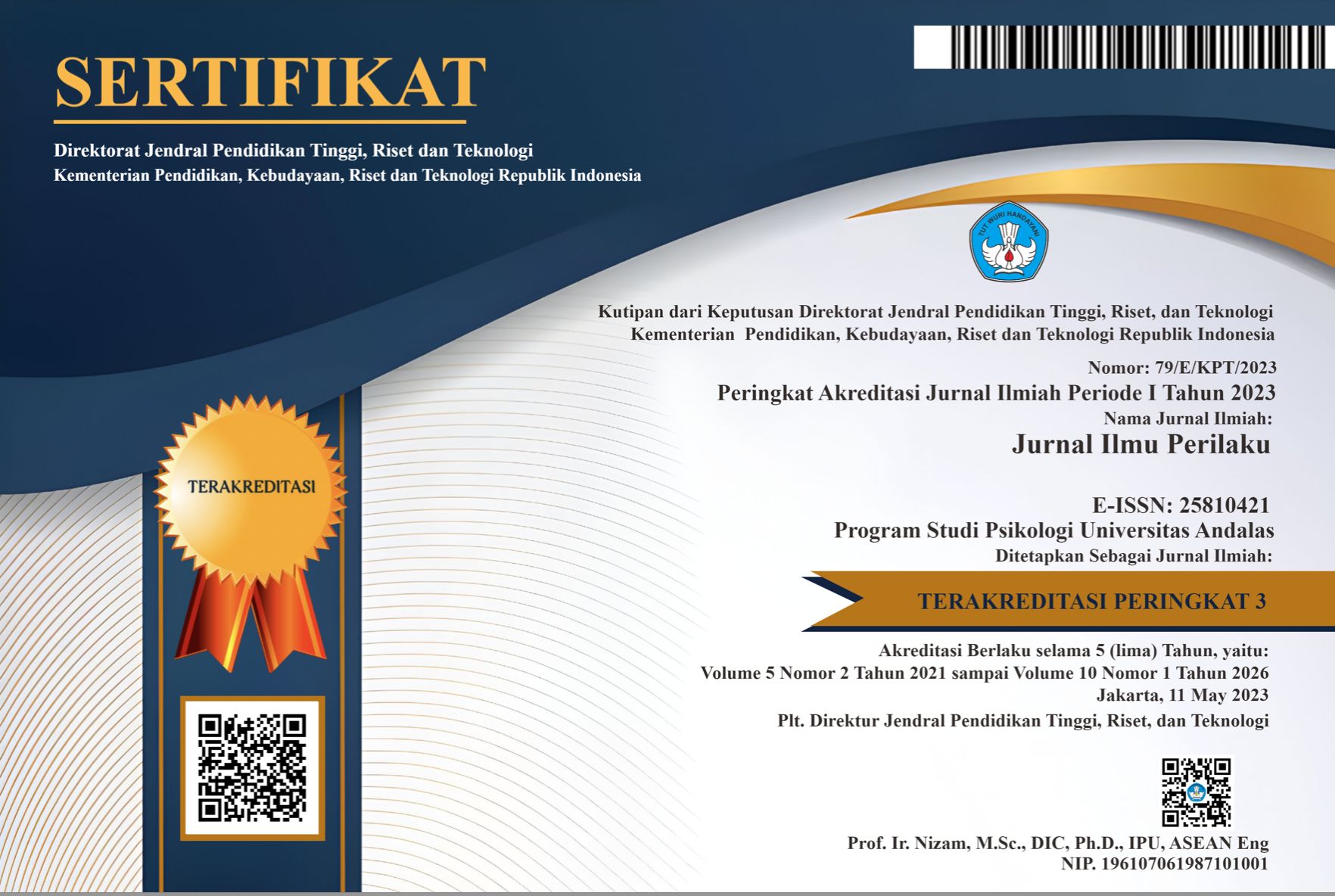
Jurnal Ilmu Perilaku is a scholarly journal associated with the Department of Psychology, Universitas Andalas, Indonesia.
The journal's official website should provide accurate and accessible information about its identity and publishing arrangements.
This information should include, where applicable:
-
Official journal title.
-
International Standard Serial Number (ISSN).
-
Publisher and responsible institutional unit.
-
Journal aims and scope.
-
Editorial team and relevant affiliations.
-
Publication frequency.
-
Peer review procedures.
-
Open access and licensing arrangements.
-
Author fees and applicable waivers.
-
Contact information.
-
Publication ethics policies.
The publisher is responsible for supporting an organizational environment in which editorial integrity and scholarly independence can be maintained.
The publisher should ensure that journal identity and ownership information is presented transparently and consistently.
4. Editorial Governance Structure
Jurnal Ilmu Perilaku should maintain an editorial governance structure appropriate to its scholarly scope, publication activities, and operational needs.
The structure may include:
-
Editor-in-Chief.
-
Associate Editors or Section Editors.
-
Editorial Board Members.
-
Managing Editor or Editorial Secretary.
-
Copyeditors and Production Editors.
-
Technical or Journal Administration Personnel.
-
Other designated editorial roles.
Each role should have clearly defined responsibilities.
The journal should publish an up-to-date editorial team listing that accurately identifies individuals serving in formal editorial positions.
Editorial titles must not be assigned or displayed without the relevant individual's knowledge and consent.
5. Responsibilities of the Editor-in-Chief
The Editor-in-Chief is responsible for overseeing the scholarly and ethical quality of the journal's editorial operations.
Responsibilities include:
-
Providing editorial leadership.
-
Maintaining the journal's aims and scope.
-
Overseeing manuscript assessment and peer review.
-
Ensuring consistent application of editorial policies.
-
Protecting editorial independence.
-
Managing editorial conflicts of interest.
-
Supervising appropriate responses to publication ethics concerns.
-
Supporting editorial board development.
-
Promoting timely and professional editorial communication.
-
Overseeing post-publication editorial actions.
-
Coordinating periodic evaluation of editorial performance.
The Editor-in-Chief should ensure that editorial decisions are based on scholarly merit, methodological quality, ethical acceptability, and relevance to the journal.
6. Responsibilities of Editorial Board Members
Editorial board members contribute to the scholarly development, quality assurance, and ethical governance of the journal.
Their responsibilities may include:
-
Advising on editorial policy and journal development.
-
Supporting appropriate peer review processes.
-
Providing expertise within the journal's scope.
-
Identifying emerging scholarly issues.
-
Promoting research integrity.
-
Supporting journal quality improvement.
-
Disclosing relevant conflicts of interest.
-
Maintaining professional and ethical conduct.
Editorial board membership does not automatically authorize an individual to influence editorial decisions outside their assigned responsibilities.
Members must respect confidentiality and editorial independence.
7. Editorial Appointments and Membership
The journal should establish transparent and appropriate procedures for appointing editors and editorial board members.
Appointments should consider:
-
Relevant academic qualifications.
-
Scholarly expertise.
-
Research and publication experience.
-
Professional integrity.
-
Familiarity with publication ethics.
-
Ability to fulfill editorial responsibilities.
-
Diversity of relevant disciplinary perspectives.
-
Availability and commitment to journal activities.
Appointments should be based on scholarly and professional considerations rather than inappropriate personal, financial, or institutional influence.
The relevant appointing authority, term of service, renewal arrangements, and removal procedures should be documented through the journal's governance arrangements.
The journal should maintain accurate records of editorial appointments and changes.
8. Editorial Independence
Jurnal Ilmu Perilaku is committed to protecting editorial decisions from inappropriate external influence.
Editorial decisions must be based on:
-
Scholarly relevance.
-
Originality.
-
Methodological quality.
-
Research integrity.
-
Ethical compliance.
-
Scientific contribution.
-
Appropriate peer review assessment.
Decisions must not be improperly influenced by:
-
Financial interests.
-
Institutional pressure.
-
Personal relationships.
-
Academic position or seniority.
-
Commercial considerations.
-
Sponsorship arrangements.
-
Political or organizational interests.
-
The identity or reputation of an author alone.
The publisher and institutional management should respect the professional independence of editors in making decisions concerning individual manuscripts.
Administrative oversight must not be used to improperly interfere with scholarly editorial judgment.
9. Relationship Between Publisher and Editorial Team
The publisher and editorial team have distinct but complementary responsibilities.
The publisher supports the journal's institutional, administrative, technical, and operational functions.
The editorial team is responsible for scholarly assessment, peer review, publication ethics, and editorial decisions.
The relationship should be based on:
-
Clearly defined responsibilities.
-
Mutual respect for professional roles.
-
Transparent communication.
-
Protection of editorial independence.
-
Appropriate accountability.
-
Responsible use of journal resources.
-
Commitment to publication ethics.
Where disagreements arise concerning governance or editorial responsibilities, they should be addressed through fair and documented procedures.
10. Manuscript Management and Editorial Workflow
The journal should maintain a consistent manuscript management process that supports fair and efficient editorial assessment.
The workflow should include appropriate procedures for:
-
Manuscript submission.
-
Initial editorial screening.
-
Scope and formatting assessment.
-
Research ethics screening.
-
Reviewer selection.
-
Peer review.
-
Editorial decisions.
-
Manuscript revision.
-
Final acceptance.
-
Copyediting and production.
-
Publication.
-
Post-publication communication and corrections.
Editorial decisions and significant workflow actions should be appropriately documented.
The journal should communicate manuscript status and editorial requirements clearly to authors.
The publication workflow must remain consistent with the journal's publicly stated peer review and editorial policies.
11. Peer Review Management
Jurnal Ilmu Perilaku should maintain a peer review process that is fair, objective, confidential, and appropriate to its scholarly scope.
Editors are responsible for selecting reviewers with relevant expertise and identifying potential conflicts of interest.
The journal should establish procedures for:
-
Reviewer invitation and selection.
-
Reviewer confidentiality.
-
Disclosure of competing interests.
-
Evaluation of reviewer reports.
-
Editorial assessment of conflicting recommendations.
-
Handling of inappropriate reviewer conduct.
-
Detection and prevention of peer review manipulation.
Reviewer recommendations inform editorial decisions but do not automatically determine manuscript acceptance or rejection.
The journal's detailed procedures should be explained in its Peer Review Policy.
12. Conflicts of Interest in Journal Management
Individuals involved in journal governance and management must disclose relevant competing interests.
Potential conflicts may arise from:
-
Personal or professional relationships.
-
Financial interests.
-
Institutional affiliations.
-
Research collaborations.
-
Editorial appointments.
-
Sponsorship or funding relationships.
-
Other circumstances that could affect impartiality.
Material conflicts should be managed through appropriate safeguards.
Individuals with relevant conflicts must not exercise inappropriate influence over affected editorial decisions or investigations.
The journal's Conflicts of Interest / Competing Interests Policy applies to editorial and management activities.
13. Financial Transparency and Sustainability
The journal should maintain transparent information regarding its financial arrangements and publishing business model.
Where applicable, financial support may involve institutional funding, publication-related revenue, sponsorship, or other lawful sources.
The journal should disclose author-facing charges accurately, including any applicable article processing charges, submission fees, or other publication fees.
If no author fees are charged, this should be stated clearly.
Any fee changes must be communicated transparently.
Financial considerations must not determine editorial acceptance or rejection.
The journal should seek sustainable operational arrangements that support scholarly quality, publication continuity, and ethical publishing.
14. Advertising and Sponsorship
Where advertising or sponsorship is accepted, the journal must maintain a clear separation between commercial activities and editorial decisions.
Advertisers and sponsors must not influence:
-
Manuscript selection.
-
Peer review.
-
Editorial decisions.
-
Publication ethics investigations.
-
Corrections or retractions.
-
The interpretation of scholarly findings.
Advertising and sponsorship arrangements should be governed by transparent policies.
The journal must not make misleading claims regarding indexing, editorial quality, publication guarantees, or other services.
15. Website Management and Transparency
The journal's official website is an important source of information for authors, reviewers, readers, and other stakeholders.
Jurnal Ilmu Perilaku should ensure that website information is accurate, accessible, and regularly reviewed.
Relevant information includes:
-
Journal identity.
-
Publisher and ownership.
-
Aims and scope.
-
Editorial team.
-
Author Guidelines.
-
Peer Review Policy.
-
Publication Ethics.
-
Copyright and licensing.
-
Open access arrangements.
-
Publication fees.
-
Archiving and preservation.
-
Contact information.
Outdated, inconsistent, or misleading information should be corrected promptly.
The journal should avoid displaying unsupported claims concerning indexing, accreditation, impact metrics, or membership in professional organizations.
16. Open Journal Systems Management
The journal should maintain appropriate administrative and technical procedures for its publishing platform, including Open Journal Systems (OJS), where used.
These procedures should address:
-
User account management.
-
Role-based access permissions.
-
Secure authentication practices.
-
Software maintenance and updates.
-
Data backup arrangements.
-
Protection of confidential manuscripts.
-
Management of editorial records.
-
Publication metadata accuracy.
-
DOI and article identifier management, where applicable.
-
Monitoring of technical errors affecting publication access.
Administrative access should be limited to authorized personnel.
Technical maintenance must be conducted in a manner that protects editorial records, personal information, and publication continuity.
17. Confidentiality and Personal Data Protection
Journal management activities may involve personal information concerning authors, reviewers, editors, and other individuals.
The journal must manage such information responsibly and in accordance with applicable privacy and data protection requirements.
Confidential information may include:
-
Manuscripts under review.
-
Reviewer identities, where protected by the review model.
-
Editorial correspondence.
-
Personal contact information.
-
Conflict-of-interest declarations.
-
Research ethics documentation.
-
Unpublished research data.
Access to confidential information should be restricted to individuals with legitimate editorial or administrative responsibilities.
The journal must not disclose confidential information for unauthorized purposes.
18. Editorial Records and Documentation
The journal should maintain appropriate records of editorial and publishing activities.
Records may include:
-
Manuscript submissions.
-
Editorial decisions.
-
Reviewer invitations and reports.
-
Author correspondence.
-
Conflict-of-interest disclosures.
-
Research ethics documentation.
-
Complaints and appeals.
-
Publication corrections.
-
Retractions and expressions of concern.
-
Changes to editorial governance.
Records should be stored securely and retained in accordance with applicable legal, institutional, and journal requirements.
The journal should establish appropriate procedures for authorized access, retention, and secure disposal.
19. Digital Preservation and Publication Continuity
Jurnal Ilmu Perilaku recognizes the importance of preserving published scholarly content and maintaining long-term accessibility.
The journal should establish and publicly describe appropriate digital preservation arrangements.
These may involve recognized preservation services, institutional repositories, secure backups, or other suitable mechanisms.
The journal must distinguish between routine technical backups and formal long-term digital preservation.
Participation in a preservation service should be claimed publicly only when the relevant arrangement has been established and verified.
The journal should maintain procedures for protecting published articles, metadata, and other essential publication records.
20. Publication Schedule and Operational Planning
The journal should publish accurate information about its publication frequency and schedule.
Editorial and production planning should support the timely publication of accepted scholarly work.
The journal should avoid making publication commitments that cannot reasonably be fulfilled.
Where significant publication delays occur, the journal should communicate relevant information transparently.
Changes to publication frequency or operational arrangements should be reflected consistently across the journal website and relevant indexing records.
21. Ethical Oversight and Research Integrity
The journal is responsible for maintaining procedures for identifying and responding to credible research integrity concerns.
Such concerns may include:
-
Plagiarism.
-
Data fabrication or falsification.
-
Authorship manipulation.
-
Undisclosed competing interests.
-
Unethical research involving human participants.
-
Peer review manipulation.
-
Duplicate or redundant publication.
-
Unauthorized use of intellectual property.
The journal should follow its established publication ethics policies and relevant COPE guidance.
Where formal investigation is required beyond the journal's authority, the editorial team may cooperate with appropriate research institutions or other competent bodies.
22. Complaints and Appeals in Journal Governance
The journal should provide accessible procedures for raising concerns about editorial decisions, journal management, or publication practices.
Complaints should be handled fairly, confidentially, and without retaliation against individuals acting in good faith.
Complaints involving an editor or journal manager must be reviewed by an appropriately independent individual or authority.
Where a complaint concerns the Editor-in-Chief, the journal's governance arrangements should provide an independent escalation pathway.
The journal's Complaints and Appeals Policy governs the relevant procedures.
23. Corrections, Retractions, and Post-Publication Responsibilities
Journal management responsibilities continue after an article has been published.
The journal must maintain appropriate procedures for addressing:
-
Errors in published articles.
-
Concerns regarding data reliability.
-
Ethical misconduct allegations.
-
Authorship corrections.
-
Expressions of concern.
-
Retractions.
-
Exceptional article removal.
-
Post-publication discussion.
Corrective actions must be transparent, proportionate, and consistent with relevant COPE guidance.
Retractions are intended to correct the scholarly record rather than punish authors.
The journal should preserve appropriate links between original articles and their correction or retraction notices.
24. Professional Conduct and Non-Discrimination
Individuals involved in journal management must conduct their responsibilities professionally and respectfully.
The journal should promote fair treatment regardless of personal background, institutional affiliation, nationality, gender, or other characteristics unrelated to scholarly evaluation.
Harassment, intimidation, retaliation, and discriminatory conduct are incompatible with ethical journal management.
Editors, reviewers, and administrative personnel should communicate professionally and maintain appropriate boundaries in their interactions.
25. Journal Performance and Quality Improvement
Jurnal Ilmu Perilaku should periodically evaluate its editorial and operational performance.
Relevant areas for evaluation may include:
-
Quality and consistency of peer review.
-
Timeliness of editorial processing.
-
Compliance with publication ethics policies.
-
Accuracy of journal website information.
-
Quality of published article metadata.
-
Effectiveness of editorial communication.
-
Accessibility of published content.
-
Digital preservation arrangements.
-
Editorial board participation.
-
Responsiveness to complaints and corrections.
Evaluation results should inform reasonable improvements in journal procedures and governance.
Performance indicators must not be used to compromise editorial independence or encourage inappropriate publication practices.
26. Governance Changes and Continuity
Changes in journal leadership, editorial board membership, publishing arrangements, or technical administration should be managed transparently.
The journal should seek to ensure continuity of:
-
Editorial records.
-
Published content.
-
Manuscript processing.
-
Author and reviewer communication.
-
Publication metadata.
-
Website accessibility.
-
Research integrity procedures.
Significant changes to journal ownership, publishing responsibility, or editorial governance should be communicated appropriately.
The journal must not misrepresent its institutional affiliations or continuity of publication.
27. Policy Enforcement
Individuals involved in journal governance are expected to comply with this policy and related editorial procedures.
Concerns about governance failures or policy violations should be evaluated fairly and through appropriate institutional or editorial channels.
Responses should be proportionate to the nature and seriousness of the issue.
Where necessary, corrective measures may include:
-
Clarification of responsibilities.
-
Revision of operational procedures.
-
Reassignment of editorial duties.
-
Additional training or guidance.
-
Independent review of disputed decisions.
-
Referral to an appropriate institutional authority.
Any personnel-related decisions must follow applicable institutional rules and lawful procedures.
28. Policy Review
Jurnal Ilmu Perilaku will periodically review this Journal Management Policy to maintain alignment with relevant COPE guidance, developments in scholarly publishing, and applicable institutional requirements.
The journal will seek consistency between this policy and its Editorial Team, Editorial Independence Policy, Peer Review Policy, Publication Ethics, Financial Transparency Policy, Privacy Statement, and Archiving Policy.
Material revisions should be communicated through the official journal website.
References
-
Committee on Publication Ethics (COPE). Core Practices. https://publicationethics.org/core-practices
-
Committee on Publication Ethics (COPE). Guidance and Resources. https://publicationethics.org/guidance
-
Committee on Publication Ethics (COPE). Principles of Transparency and Best Practice in Scholarly Publishing. https://doi.org/10.24318/cope.2019.1.12
-
COPE Council. COPE Retraction Guidelines. Version 3, August 2025. https://doi.org/10.24318/cope.2019.1.4