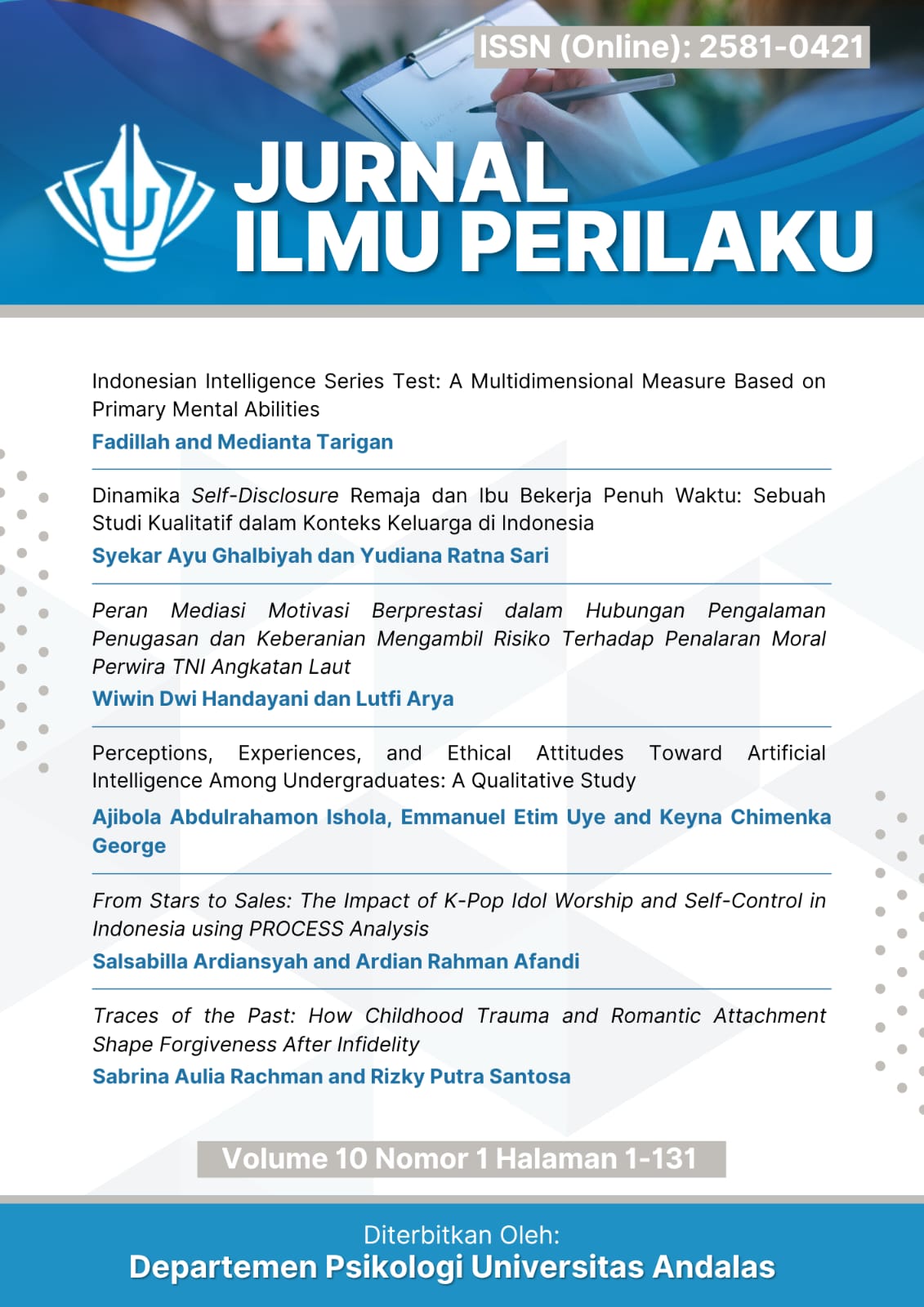
Dinamika Self-Disclosure Remaja dan Ibu Bekerja Penuh Waktu: Sebuah Studi Kualitatif dalam Konteks Keluarga di Indonesia
DOI:
https://doi.org/10.25077/jip.10.1.27-48.2026Keywords:
Working Mothers , Self-disclosure, Full-time , AdolescentsAbstract
The mother's dual role as primary caregiver and worker has the potential to influence the quality of mother-child interactions. In fact, adolescence really needs guidance and support from parents, especially mothers. This study aims to explore the dynamics of self-disclosure among adolescents with mothers who work full-time. The approach used was qualitative, with a semi- structured interview method, with four mother-teen pairs, adolescents aged at least 18 years who were living with their parents, and full-time working mothers selected using a purposive sampling technique. The data were analyzed using thematic analysis according to Braun and Clark (2021). The research results showed that the dynamics of self-disclosure were positive. The dynamics of positive self- disclosure could be seen from the quality of interactions that occurred, where adolescents considered the mother as the main attachment figure, so that they believed and felt positive emotions after telling the story. This condition also arose because of the mother's sensitivity, responsiveness, and assertive communication. Therefore, an attitude of mutual understanding was formed between mother and child regarding their respective conditions. These findings showed that although there was limited time for interaction between adolescents and full-time working mothers, the quality of interaction and information shared with each other led to a positive relationship.
Downloads
References
Baudat, S., Mantzouranis, G., Van Petegem, S., & Zimmermann, G. (2022). How Do Adolescents Manage Information in the Relationship with Their Parents? A Latent Class Analysis of Disclosure, Keeping Secrets, and Lying. Journal of Youth and Adolescence, 51(6), 1134–1152. https://doi.org/10.1007/s10964-022-01599-0
Braun, V., & Clarke, V. (2021). One size fits all? What counts as quality practice in (reflexive) thematic analysis? Qualitative Research in Psychology, 18(3), 328–352. https://doi.org/10.1080/14780887.2020.1769238
Downloads
Published
How to Cite
Issue
Section
License
Copyright (c) 2026 Syekar Ayu Ghalbiyah, Yudiana Ratnasari

This work is licensed under a Creative Commons Attribution-NonCommercial-ShareAlike 4.0 International License.
The non-commercial use of the article is governed by the Creative Commons Attribution license as currently displayed on Creative Commons Attribution-NonCommercial-ShareAlike 4.0 International License.
JIP's spirit is to disseminate articles published are as free as possible. Under the Creative Commons license, JIP permits users to copy, distribute, display, and perform the work for non-commercial purposes only. Users will also need to attribute authors and JIP on distributing works in the journal.
Please find the rights and licenses in Jurnal Ilmu Perilaku (JIP).
- License
The non-commercial use of the article will be governed by the Creative Commons Attribution license as currently displayed on Creative Commons Attribution-NonCommercial-ShareAlike 4.0 International License.
- Author’s Warranties
The author warrants that the article is original, written by stated author(s), has not been published before, contains no unlawful statements, does not infringe the rights of others, is subject to copyright that is vested exclusively in the author and free of any third party rights, and that any necessary written permissions to quote from other sources have been obtained by the author(s).
- User Rights
JIP's spirit is to disseminate articles published are as free as possible. Under the Creative Commons license, JIP permits users to copy, distribute, display, and perform the work for non-commercial purposes only. Users will also need to attribute authors and JIP on distributing works in the journal.
- Rights of Authors
Authors retain the following rights:
- Copyright, and other proprietary rights relating to the article, such as patent rights,
- The right to use the substance of the article in future own works, including lectures and books,
- The right to reproduce the article for own purposes, provided the copies are not offered for sale,
- The right to self-archive the article.
- Co-Authorship
If the article was jointly prepared by other authors, the signatory of this form warrants that he/she has been authorized by all co-authors to sign this agreement on their behalf, and agrees to inform his/her co-authors of the terms of this agreement.
- Termination
This agreement can be terminated by the author or JIP upon two months’ notice where the other party has materially breached this agreement and failed to remedy such breach within a month of being given the terminating party’s notice requesting such breach to be remedied. No breach or violation of this agreement will cause this agreement or any license granted in it to terminate automatically or affect the definition of JIP.
- Royalties
This agreement entitles the author to no royalties or other fees. To such extent as legally permissible, the author waives his or her right to collect royalties relative to the article in respect of any use of the article by JIP or its sublicensee.
- Miscellaneous
JIP will publish the article (or have it published) in the journal if the article’s editorial process is successfully completed and JIP or its sublicensee has become obligated to have the article published. JIP may conform the article to a style of punctuation, spelling, capitalization, referencing and usage that it deems appropriate. The author acknowledges that the article may be published so that it will be publicly accessible and such access will be free of charge for the readers.