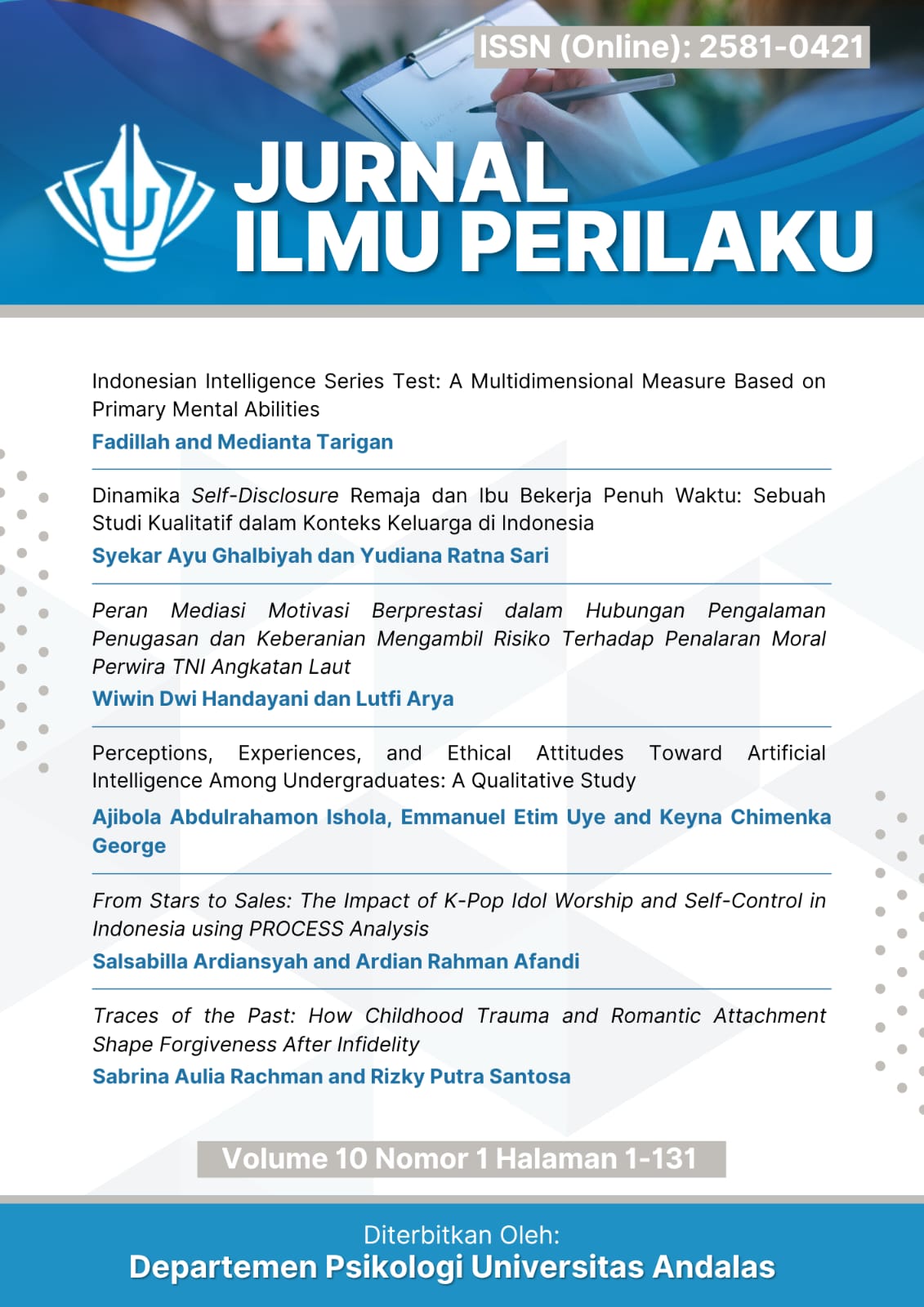
Indonesian Intelligence Series Test: A Multidimensional Measure Based on Primary Mental Abilities
DOI:
https://doi.org/10.25077/jip.10.1.1-26.2026Keywords:
cognitive, intelligence, CFA, IRT, validityAbstract
This study evaluated the initial psychometric evidence of the Indonesian Intelligence Series Test (TSKI), a locally developed, profile-based intelligence instrument designed to measure Verbal, Numerical, and Figural abilities within a hierarchical structure. Data were collected from 1,097 participants through web-based administration. The internal structure was examined using Confirmatory Factor Analysis, item characteristics using the three-parameter logistic Item Response Theory model, and construct reliability using McDonald’s Omega. The results supported the proposed hierarchical structure, in which the three ability domains were distinguishable but related through a higher-order general intelligence factor. Most items demonstrated satisfactory discrimination, difficulty, and guessing parameters, although several items in the Figural Selection and Cubes subtests required further review. Reliability was adequate for the Verbal and Numerical domains, whereas the Figural domain showed slightly lower internal consistency. These findings provide initial support for interpreting TSKI scores as both domain-based ability profiles and an overall estimate of general intelligence. The study also identifies specific areas for item revision, particularly within the Figural domain, and provides an empirical basis for further standardization and validation using more diverse samples.
Downloads
References
Abidin, Z., Kadiyono, A. L., & Widianto, H. A. S. C. (2025). Development and validation of a presidential leadership instrument. Cogent Arts & Humanities, 12(1). https://doi.org/10.1080/23311983.2025.2523655
Amthauer, R., Brocke, B. L. D., & Beauducel, A. (2001). Intelligenz-Struktur-Test 2000 R [Intelligence-structure-test 2000 R]. Hogrefe.
Arlianto, A., Prahoro, A. P., & Oktavia, A. (2024). Intercultural competence measurement tools for Indonesian students: Adaptation, testing construct validity, and measurement invariance with the MIMIC model. Jurnal Psikologi, 23(1), 1–24. https://doi.org/10.14710/jp.23.1.1-24
Bean, G. J., & Bowen, N. K. (2021). Item Response Theory and Confirmatory Factor Analysis: Complementary Approaches for Scale Development. Journal of Evidence-Based Social Work, 18(6), 597–618. https://doi.org/10.1080/26408066.2021.1906813
Boateng, G. O., Neilands, T. B., Frongillo, E. A., Melgar-Quiñonez, H. R., & Young, S. L. (2018). Best Practices for Developing and Validating Scales for Health, Social, and Behavioral Research: A Primer. Frontiers in Public Health, 6. https://doi.org/10.3389/fpubh.2018.00149
Caemmerer, J. M., Keith, T. Z., & Reynolds, M. R. (2020). Beyond individual intelligence tests: Application of Cattell-Horn-Carroll Theory. Intelligence, 79, 101433. https://doi.org/10.1016/j.intell.2020.101433
Carroll, J. B. (1993). Human Cognitive Abilities. A survey of factor-analytic studies. Camridge University Press.
deLeyer-Tiarks, J. M., Caemmerer, J. M., Bray, M. A., & Kaufman, A. S. (2024). Assessment of Human Intelligence—The State of the Art in the 2020s. Journal of Intelligence, 12(8), 72. https://doi.org/10.3390/jintelligence12080072
Deng, L., & Chan, W. (2017). Testing the Difference Between Reliability Coefficients Alpha and Omega. Educational and Psychological Measurement, 77(2), 185–203. https://doi.org/10.1177/0013164416658325
Euler, M. J., Vehar, J. V., & Guevara, J. E. (2023). Theories of Intelligence (pp. 289–323). https://doi.org/10.1007/978-3-031-24926-6_15
Flora, D. B. (2020). Your Coefficient Alpha Is Probably Wrong, but Which Coefficient Omega Is Right? A Tutorial on Using R to Obtain Better Reliability Estimates. Advances in Methods and Practices in Psychological Science, 3(4), 484–501. https://doi.org/10.1177/2515245920951747
Gustafsson, J.-E. (1984). A unifying model for the structure of intellectual abilities. Intelligence, 8(3), 179–203. https://doi.org/10.1016/0160-2896(84)90008-4
Hair Jr, J. F., Black, W. C., Babin, B. J., & Anderson, R. E. (2019). Multivarate Data Analysis. Cengage Learning, Cheriton House, NW.
Hartono, W., Hadi, S., & Rosnawati, R. (2024). Optimizing Item Construction in Diagnostic Mathematics Test. TEM Journal, 1106–1115. https://doi.org/10.18421/TEM132-25
Hayes, A. F., & Coutts, J. J. (2020). Use Omega Rather than Cronbach’s Alpha for Estimating Reliability. But…. Communication Methods and Measures, 14(1), 1–24. https://doi.org/10.1080/19312458.2020.1718629
Hidayatullah, M. S., Kadiyono, A. L., Sulastiana, M., & Nugraha, Y. (2026). Cross-cultural adaptation and psychometric validation of the Indonesian version of the behavioral integrity scale for organizational settings. BMC Psychology. https://doi.org/10.1186/s40359-026-04259-1
Kline, R. B. (2023). Principles and Practice of Structural Equation Modeling. Guilford publications.
Lang, J. W. B., Kersting, M., & Beauducel, A. (2016). Hierarchies of factor solutions in the intelligence domain: Applying methodology from personality psychology to gain insights into the nature of intelligence. Learning and Individual Differences, 47, 37–50. https://doi.org/10.1016/j.lindif.2015.12.003
Marcoulides, K. M., Foldnes, N., & Grønneberg, S. (2020). Assessing Model Fit in Structural Equation Modeling Using Appropriate Test Statistics. Structural Equation Modeling: A Multidisciplinary Journal, 27(3), 369–379. https://doi.org/10.1080/10705511.2019.1647785
McGrew, K. S. (2023). Carroll’s Three-Stratum (3S) Cognitive Ability Theory at 30 Years: Impact, 3S-CHC Theory Clarification, Structural Replication, and Cognitive–Achievement Psychometric Network Analysis Extension. Journal of Intelligence, 11(2), 32. https://doi.org/10.3390/jintelligence11020032
Messick, S. (1995). Validity of psychological assessment: Validation of inferences from persons’ responses and performances as scientific inquiry into score meaning. American Psychologist. https://doi.org/10.1037/0003-066X.50.9.741
Reynolds, M. R., & Keith, T. Z. (2017). Multi-group and hierarchical confirmatory factor analysis of the Wechsler Intelligence Scale for Children—Fifth Edition: What does it measure? Intelligence, 62, 31–47. https://doi.org/10.1016/j.intell.2017.02.005
Shi, D., Lee, T., & Maydeu-Olivares, A. (2019). Understanding the Model Size Effect on SEM Fit Indices. Educational and Psychological Measurement, 79(2), 310–334. https://doi.org/10.1177/0013164418783530
Thurstone, L. L. (1947). Multiple factor analysis. University of Chicago Press.
Viladrich, C., Angulo-Brunet, A., & Doval, E. (2017). Un viaje alrededor de alfa y omega para estimar la fiabilidad de consistencia interna. Anales de Psicología, 33(3), 755. https://doi.org/10.6018/analesps.33.3.268401
Yim, L. W. K., Lye, C. Y., & Koh, P. W. (2024). A psychometric evaluation of an item bank for an English reading comprehension tool using Rasch analysis. REID (Research and Evaluation in Education), 10(1), 18–34. https://doi.org/10.21831/reid.v10i1.65284
Downloads
Published
How to Cite
Issue
Section
License
Copyright (c) 2026 Fadillah, Medianta Tarigan

This work is licensed under a Creative Commons Attribution-NonCommercial-ShareAlike 4.0 International License.
The non-commercial use of the article is governed by the Creative Commons Attribution license as currently displayed on Creative Commons Attribution-NonCommercial-ShareAlike 4.0 International License.
JIP's spirit is to disseminate articles published are as free as possible. Under the Creative Commons license, JIP permits users to copy, distribute, display, and perform the work for non-commercial purposes only. Users will also need to attribute authors and JIP on distributing works in the journal.
Please find the rights and licenses in Jurnal Ilmu Perilaku (JIP).
- License
The non-commercial use of the article will be governed by the Creative Commons Attribution license as currently displayed on Creative Commons Attribution-NonCommercial-ShareAlike 4.0 International License.
- Author’s Warranties
The author warrants that the article is original, written by stated author(s), has not been published before, contains no unlawful statements, does not infringe the rights of others, is subject to copyright that is vested exclusively in the author and free of any third party rights, and that any necessary written permissions to quote from other sources have been obtained by the author(s).
- User Rights
JIP's spirit is to disseminate articles published are as free as possible. Under the Creative Commons license, JIP permits users to copy, distribute, display, and perform the work for non-commercial purposes only. Users will also need to attribute authors and JIP on distributing works in the journal.
- Rights of Authors
Authors retain the following rights:
- Copyright, and other proprietary rights relating to the article, such as patent rights,
- The right to use the substance of the article in future own works, including lectures and books,
- The right to reproduce the article for own purposes, provided the copies are not offered for sale,
- The right to self-archive the article.
- Co-Authorship
If the article was jointly prepared by other authors, the signatory of this form warrants that he/she has been authorized by all co-authors to sign this agreement on their behalf, and agrees to inform his/her co-authors of the terms of this agreement.
- Termination
This agreement can be terminated by the author or JIP upon two months’ notice where the other party has materially breached this agreement and failed to remedy such breach within a month of being given the terminating party’s notice requesting such breach to be remedied. No breach or violation of this agreement will cause this agreement or any license granted in it to terminate automatically or affect the definition of JIP.
- Royalties
This agreement entitles the author to no royalties or other fees. To such extent as legally permissible, the author waives his or her right to collect royalties relative to the article in respect of any use of the article by JIP or its sublicensee.
- Miscellaneous
JIP will publish the article (or have it published) in the journal if the article’s editorial process is successfully completed and JIP or its sublicensee has become obligated to have the article published. JIP may conform the article to a style of punctuation, spelling, capitalization, referencing and usage that it deems appropriate. The author acknowledges that the article may be published so that it will be publicly accessible and such access will be free of charge for the readers.