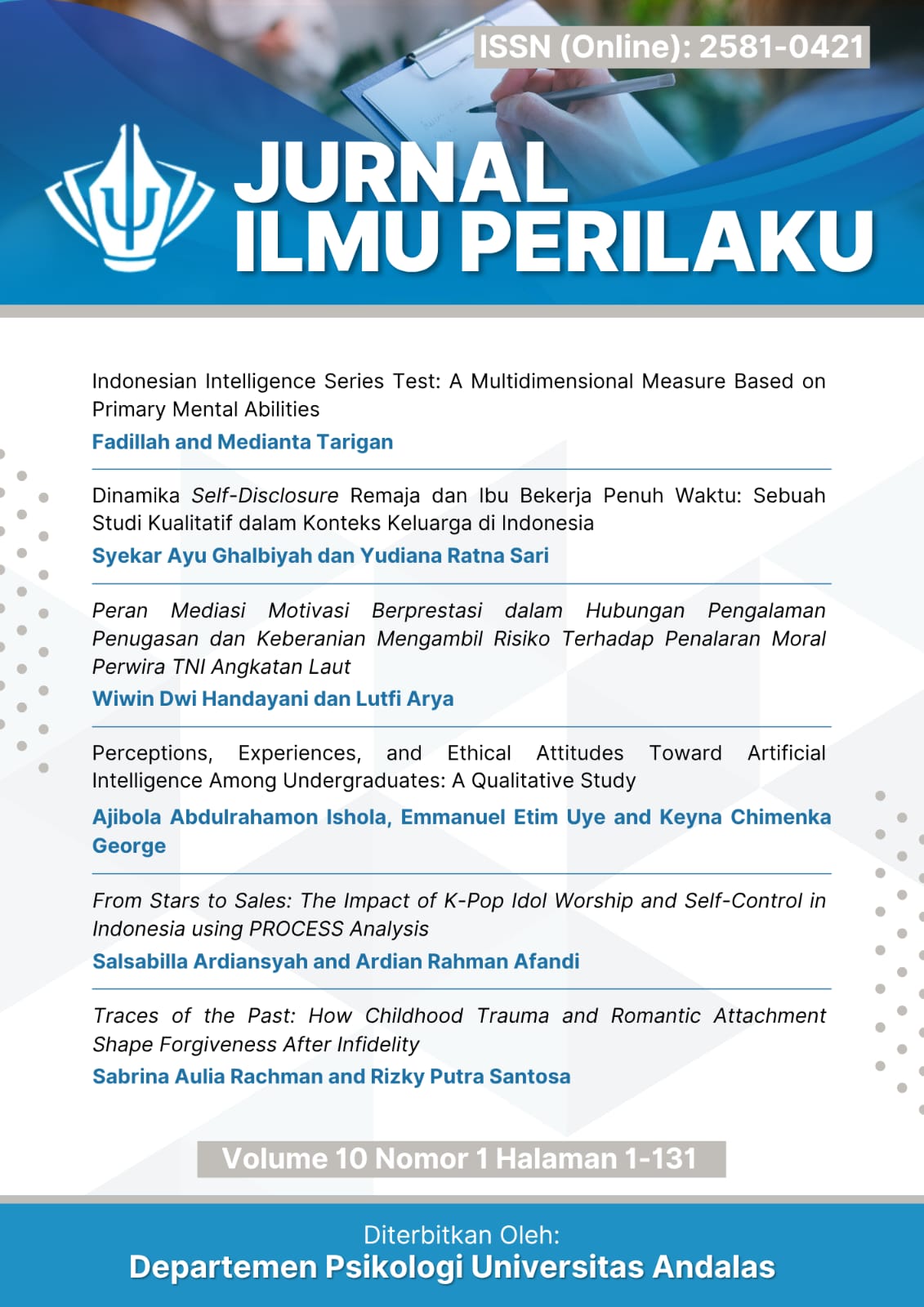
Peran Mediasi Motivasi Berprestasi dalam Hubungan Pengalaman Penugasan dan Keberanian Mengambil Risiko Terhadap Penalaran Moral Perwira TNI Angkatan Laut
DOI:
https://doi.org/10.25077/jip.10.1.49-66.2026Keywords:
moral reasoning, achievement motivation, risk-taking, navy officers, assignment experiencesAbstract
This study examined the relationships among assignment experience, risk-taking propensity, achievement motivation, and moral reasoning in Indonesian Navy officers. This topic is important because professional experience alone does not guarantee ethical maturity in hierarchical organizations. The study aimed to test whether assignment experience and risk-taking affected moral reasoning directly, or indirectly through achievement motivation. A quantitative survey was conducted with 398 officers aged 35–42 years. Moral reasoning was measured using the Defining Issues Test (DIT), while achievement motivation and risk-taking were measured using adapted Likert scales. Data were analyzed using Structural Equation Modeling (SEM). Descriptive results showed that the largest proportion of officers were at Stage 5 social contract orientation (22.9%), and 9.5% reached Stage 6 universal ethical principles. Structural analysis showed that assignment experience significantly predicted achievement motivation (p < .001; C.R. = 7.758), and risk-taking also significantly predicted achievement motivation (p = .002; C.R. = 3.109). However, neither variable directly predicted moral reasoning (p = .062 and p = .784, respectively). Achievement motivation had a significant positive effect on moral reasoning (p = .004; C.R. = 2.851) and fully mediated the relationships between the independent variables and moral reasoning. The model demonstrated good fit indices (Chi-square/df = 1.829; GFI = .942; CFI = .952; RMSEA = .046). These findings suggest that ethical development in military settings depends more on value-based achievement motivation than on experience alone. This highlights the need for leadership training that combines performance orientation with ethical reflection.
Downloads
References
Aquino, K., & Reed, A., II. (2002). The self-importance of moral identity. Journal of Personality and Social Psychology, 83(6), 1423–1440. https://doi.org/10.1037/0022-3514.83.6.1423
Bucata, G., & Andrei, A. (2024). Leadership and management changes in military organizations and their impact on professional performance. Land Forces Academy Review, 29(1), 45–58.
Fischer, K. W., Yan, Z., & Stewart, J. (2012). Adult cognitive development: Dynamics in the developmental web. In P. D. Zelazo (Ed.), The Oxford handbook of developmental psychology (Vol. 1, pp. 491–516). Oxford University Press.
Haidt, J. (2001). The emotional dog and its rational tail: A social intuitionist approach to moral judgment. Psychological Review, 108(4), 814–834. https://doi.org/10.1037/0033-295X.108.4.814
Hardy, S. A., & Carlo, G. (2011). Moral identity: What is it, how does it develop, and is it linked to moral action? Child Development Perspectives, 5(3), 212–218. https://doi.org/10.1111/j.1750-8606.2011.00189.x
Henschke, A., & Sedmak, C. (2025). Ethical decision-making in contemporary military operations. Ethical Theory and Moral Practice, 28(2), 311–329.
Downloads
Published
How to Cite
Issue
Section
License
Copyright (c) 2026 Wiwin Dwi Handayani; Lutfi Arya

This work is licensed under a Creative Commons Attribution-NonCommercial-ShareAlike 4.0 International License.
The non-commercial use of the article is governed by the Creative Commons Attribution license as currently displayed on Creative Commons Attribution-NonCommercial-ShareAlike 4.0 International License.
JIP's spirit is to disseminate articles published are as free as possible. Under the Creative Commons license, JIP permits users to copy, distribute, display, and perform the work for non-commercial purposes only. Users will also need to attribute authors and JIP on distributing works in the journal.
Please find the rights and licenses in Jurnal Ilmu Perilaku (JIP).
- License
The non-commercial use of the article will be governed by the Creative Commons Attribution license as currently displayed on Creative Commons Attribution-NonCommercial-ShareAlike 4.0 International License.
- Author’s Warranties
The author warrants that the article is original, written by stated author(s), has not been published before, contains no unlawful statements, does not infringe the rights of others, is subject to copyright that is vested exclusively in the author and free of any third party rights, and that any necessary written permissions to quote from other sources have been obtained by the author(s).
- User Rights
JIP's spirit is to disseminate articles published are as free as possible. Under the Creative Commons license, JIP permits users to copy, distribute, display, and perform the work for non-commercial purposes only. Users will also need to attribute authors and JIP on distributing works in the journal.
- Rights of Authors
Authors retain the following rights:
- Copyright, and other proprietary rights relating to the article, such as patent rights,
- The right to use the substance of the article in future own works, including lectures and books,
- The right to reproduce the article for own purposes, provided the copies are not offered for sale,
- The right to self-archive the article.
- Co-Authorship
If the article was jointly prepared by other authors, the signatory of this form warrants that he/she has been authorized by all co-authors to sign this agreement on their behalf, and agrees to inform his/her co-authors of the terms of this agreement.
- Termination
This agreement can be terminated by the author or JIP upon two months’ notice where the other party has materially breached this agreement and failed to remedy such breach within a month of being given the terminating party’s notice requesting such breach to be remedied. No breach or violation of this agreement will cause this agreement or any license granted in it to terminate automatically or affect the definition of JIP.
- Royalties
This agreement entitles the author to no royalties or other fees. To such extent as legally permissible, the author waives his or her right to collect royalties relative to the article in respect of any use of the article by JIP or its sublicensee.
- Miscellaneous
JIP will publish the article (or have it published) in the journal if the article’s editorial process is successfully completed and JIP or its sublicensee has become obligated to have the article published. JIP may conform the article to a style of punctuation, spelling, capitalization, referencing and usage that it deems appropriate. The author acknowledges that the article may be published so that it will be publicly accessible and such access will be free of charge for the readers.