Publication Ethics
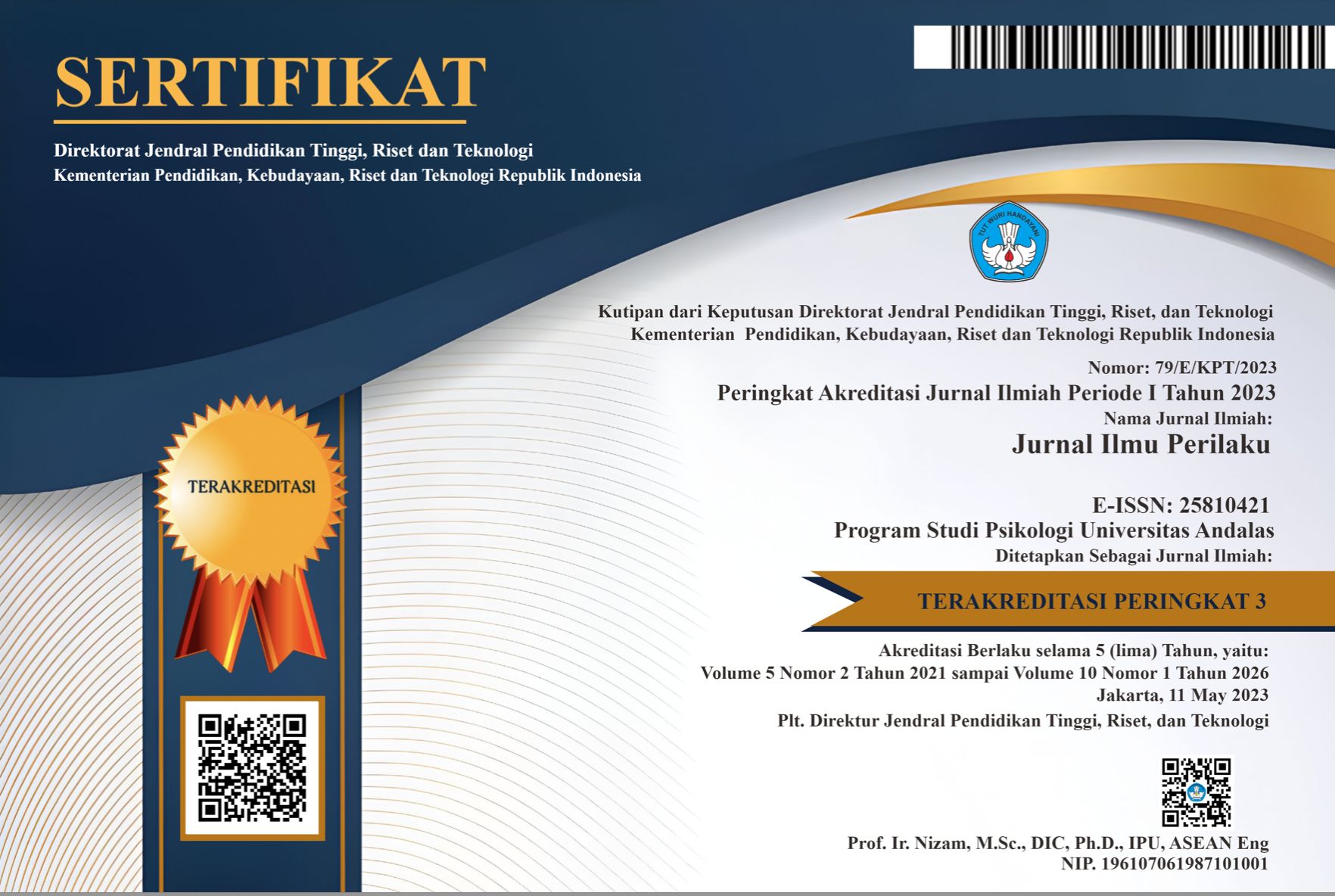
Jurnal Ilmu Perilaku (JIP) is a peer-reviewed, open-access scholarly journal published by the Department of Psychology, Universitas Andalas, Indonesia. The journal is committed to promoting ethical research, responsible authorship, editorial independence, transparent peer review, and the integrity of the scholarly record in psychology and behavioral sciences.
The journal's publication ethics and editorial policies are developed with reference to the Core Practices of the Committee on Publication Ethics (COPE) and the Principles of Transparency and Best Practice in Scholarly Publishing.
These policies apply to authors, editors, editorial board members, reviewers, publishers, and other parties involved in the journal's publication process.
1. Allegations of Misconduct
Jurnal Ilmu Perilaku is committed to addressing allegations of research and publication misconduct fairly, objectively, confidentially, and consistently.
Potential misconduct includes plagiarism, fabrication or falsification of research data, unethical research practices, inappropriate authorship, duplicate publication, manipulation of peer review, undisclosed competing interests, and other practices that compromise scholarly integrity.
Concerns may be raised by authors, reviewers, readers, research institutions, or other parties. The editorial team will assess credible allegations and determine appropriate actions based on the available evidence and relevant COPE guidance.
Where necessary, the journal may request explanations or supporting documentation, consult relevant institutions, and consider editorial actions before or after publication.
Related Policy: Allegations of Misconduct.
2. Authorship and Contributorship
Jurnal Ilmu Perilaku recognizes authorship as both scholarly credit and responsibility for the integrity of published research.
All listed authors must have made substantial scholarly contributions, approved the manuscript for publication, and accepted responsibility for their contributions.
Individuals who provide assistance without meeting the journal's authorship criteria should be appropriately acknowledged rather than listed as authors.
The corresponding author is responsible for ensuring that the author list, author order, institutional affiliations, and contribution information are accurate and approved by all authors.
Requests for authorship changes must be supported by appropriate explanations and documentation. Disputes will be handled fairly, with institutional involvement where necessary.
Related Policy: Authorship and Contributorship.
3. Complaints and Appeals
Jurnal Ilmu Perilaku recognizes the right of authors, reviewers, readers, and other stakeholders to raise concerns about editorial procedures, publication decisions, ethical conduct, and journal management.
Complaints and appeals must be evaluated objectively and without retaliation.
Authors may appeal editorial decisions by providing a reasoned explanation and relevant supporting evidence. An appeal does not automatically guarantee reconsideration or acceptance.
Where possible, individuals directly involved in the disputed decision should not be solely responsible for evaluating the complaint.
The journal will seek to provide a fair response and communicate the outcome to the complainant, subject to confidentiality and applicable legal requirements.
Related Policy: Complaints and Appeals.
4. Conflicts of Interest / Competing Interests
Jurnal Ilmu Perilaku requires transparency regarding financial, professional, institutional, personal, and other relationships that could influence, or reasonably be perceived to influence, research or editorial judgment.
Authors must disclose relevant competing interests and sources of research funding.
Reviewers and editors must disclose potential conflicts before participating in manuscript evaluation. Individuals with conflicts that could compromise impartiality should withdraw from the relevant evaluation or decision-making process.
The journal will assess disclosures and implement appropriate measures to protect editorial independence and the credibility of published research.
Related Policy: Conflicts of Interest.
5. Data and Reproducibility
Jurnal Ilmu Perilaku promotes transparent research reporting, methodological rigor, responsible data management, and reproducibility.
Authors are expected to describe research designs, sampling procedures, instruments, analytical methods, and findings accurately and in sufficient detail to support scholarly evaluation.
Research involving psychological assessments, interviews, observations, surveys, experimental procedures, or sensitive personal information must follow appropriate ethical and confidentiality safeguards.
Data sharing is encouraged where ethically and legally permissible. Public disclosure of identifiable participant information, confidential psychological records, or restricted research data must not be required when it would violate participant rights or applicable regulations.
Authors should be prepared to provide appropriate supporting information to the editorial team when legitimate concerns about research integrity arise.
Related Policy: Data and Reproducibility.
6. Ethical Oversight
Jurnal Ilmu Perilaku emphasizes the protection of human dignity, autonomy, privacy, safety, and well-being in psychological and behavioral research.
Research involving human participants must comply with applicable ethical standards, institutional requirements, and relevant laws and regulations.
Authors must provide appropriate information about ethical approval or exemption, informed consent, confidentiality, and participant protection, as applicable to the research design.
Additional safeguards are particularly important for research involving children, adolescents, individuals experiencing psychological distress, people with reduced decision-making capacity, and other potentially vulnerable populations.
Authors must ensure that published descriptions, quotations, case materials, and research data do not improperly reveal participant identities.
The journal reserves the right to request documentation supporting ethical compliance and to decline publication when serious ethical concerns remain unresolved.
Related Policy: Ethical Oversight.
7. Intellectual Property
Jurnal Ilmu Perilaku respects intellectual property rights and requires authors to acknowledge the ideas, words, data, instruments, images, and other scholarly contributions of third parties.
All submitted manuscripts must be original and must not involve plagiarism, inappropriate text recycling, or undisclosed redundant publication.
Authors are responsible for obtaining necessary permissions to reproduce copyrighted materials, including psychological instruments, assessment materials, tables, figures, and previously published content.
Copyright ownership, publishing permissions, and reuse rights are governed by the journal's applicable copyright and licensing policies.
Previously disseminated research, including theses, dissertations, conference materials, and preprints, must be disclosed where relevant and evaluated according to the journal's publication policies.
Related Policies: Intellectual Property, Plagiarism Policy, Copyright and Licensing.
8. Journal Management
Jurnal Ilmu Perilaku is published by the Department of Psychology, Universitas Andalas, and operates as a peer-reviewed, open-access scholarly journal.
The journal is committed to transparent editorial governance, responsible manuscript handling, accurate publication information, and fair editorial decisions.
Manuscripts are evaluated according to their relevance to the journal's scope, originality, scholarly contribution, methodological quality, clarity, and ethical acceptability.
The journal uses Turnitin for similarity screening. Similarity reports must be interpreted through editorial assessment rather than treated as automatic proof of plagiarism.
Editorial decisions must remain independent of inappropriate financial, institutional, personal, or other external influence.
The journal seeks to maintain accurate article metadata, accessible publication records, and clearly documented policies.
Related Policy: Journal Management.
9. Peer Review Processes
Jurnal Ilmu Perilaku subjects scholarly submissions to editorial assessment and peer review to evaluate their scientific quality, originality, methodological appropriateness, relevance, and ethical integrity.
Reviewers are expected to provide objective, constructive, evidence-based, and timely evaluations within their areas of expertise.
Submitted manuscripts and associated review materials must be treated as confidential.
Reviewers must disclose relevant competing interests and must not use unpublished information obtained during peer review for personal or professional advantage.
Editors are responsible for evaluating reviewer recommendations and making publication decisions based on scholarly merit and the journal's editorial standards.
The detailed review model, reviewer selection procedures, and decision-making process are described in the journal's dedicated peer review policy.
Related Policy: Peer Review Processes.
10. Post-Publication Discussions and Corrections
Jurnal Ilmu Perilaku recognizes that editorial responsibility continues after an article has been published.
The journal will consider credible concerns regarding published findings, methodological errors, research ethics, authorship, or publication integrity.
Depending on the nature and seriousness of the issue, appropriate editorial actions may include:
-
Publishing a correction for errors that do not invalidate the article's main findings.
-
Publishing an expression of concern when serious questions remain unresolved.
-
Retracting an article when its findings or conclusions cannot be relied upon or when other grounds for retraction are established.
-
Considering removal of content only in exceptional circumstances involving compelling legal, privacy, or safety concerns.
Retraction decisions will be guided by the COPE Retraction Guidelines, Version 3, August 2025.
Retraction notices should clearly identify the affected article, explain the reasons for the action, remain publicly accessible, and be linked to the original publication.
The purpose of retraction is to correct the scholarly record rather than punish authors.
Related Policies: Post-Publication Discussions and Corrections; Retraction Policy.
11. Archiving Policy
Jurnal Ilmu Perilaku recognizes the importance of preserving scholarly publications and maintaining the long-term accessibility of its published research.
The journal is committed to developing and maintaining appropriate digital preservation arrangements that protect the integrity, accessibility, and discoverability of published articles and their metadata.
The specific preservation services, repository arrangements, and procedures for long-term digital preservation are described in the journal's dedicated Archiving Policy.
The journal will identify only preservation services that have been verified as operational.
Related Policy: Archiving Policy.
12. Open Access Policy
Jurnal Ilmu Perilaku provides open access to its published scholarly content.
Readers may access published articles online without subscription or reading fees.
The journal supports the dissemination of psychological and behavioral research to researchers, practitioners, educators, students, policymakers, and the wider public.
Reuse, redistribution, and adaptation of published materials are subject to the copyright and licensing terms applicable to each publication.
Information concerning copyright ownership, permitted reuse, and the applicable Creative Commons license, where used, is provided through the journal's dedicated copyright and licensing policies.
Related Policy: Open Access Policy.
References
-
Committee on Publication Ethics (COPE). Core Practices. https://publicationethics.org/core-practices
-
Committee on Publication Ethics (COPE). Retraction Guidelines, Version 3, August 2025. https://doi.org/10.24318/cope.2019.1.4
-
Committee on Publication Ethics (COPE). Guidance and Resources. https://publicationethics.org/guidance
-
Principles of Transparency and Best Practice in Scholarly Publishing. https://doi.org/10.24318/cope.2019.1.12