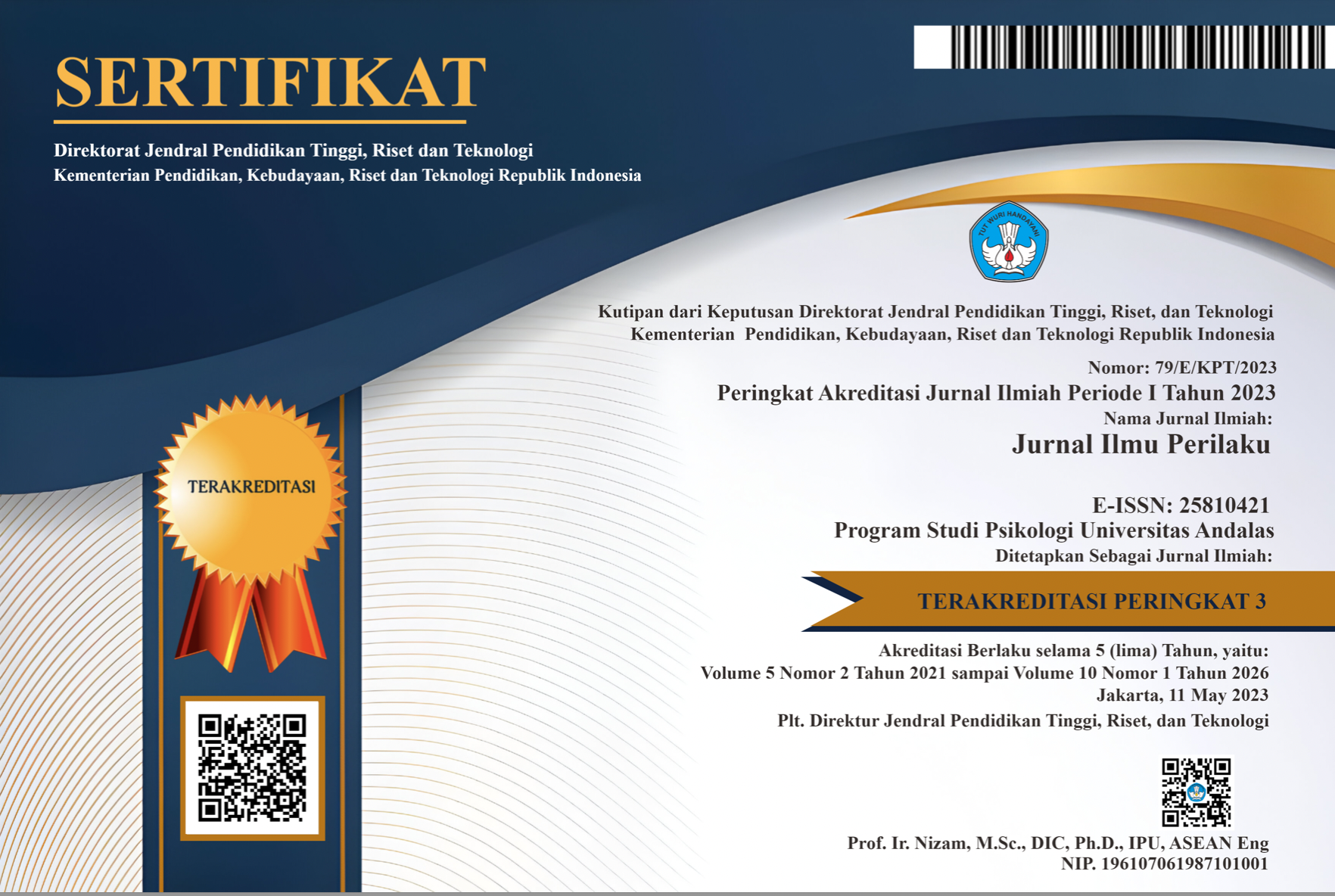
JIP Successfully Reaccredited as SINTA 3
2023-09-02
Jurnal Ilmu Perilaku (JIP) continued to be nationally accredited with SINTA 3
Read more about JIP Successfully Reaccredited as SINTA 3

https://sinta.ristekdikti.go.id Jurnal Ilmu Perilaku, with registered number ISSN 2581-0421 (online), is published by the Department of Psychology Universitas Andalas. Jurnal Ilmu Perilaku publishes original articles on new knowledge and research or application with current issues in Indonesian Psychology. All submitted manuscripts will be subjected to the peer review process following a thorough inspection by the editors. The journal periodically publishes two times a year (June and December). Publication in this journal is free of charge, and all published papers are available online through open access.
Jurnal Ilmu Perilaku (JIP) continued to be nationally accredited with SINTA 3
Read more about JIP Successfully Reaccredited as SINTA 3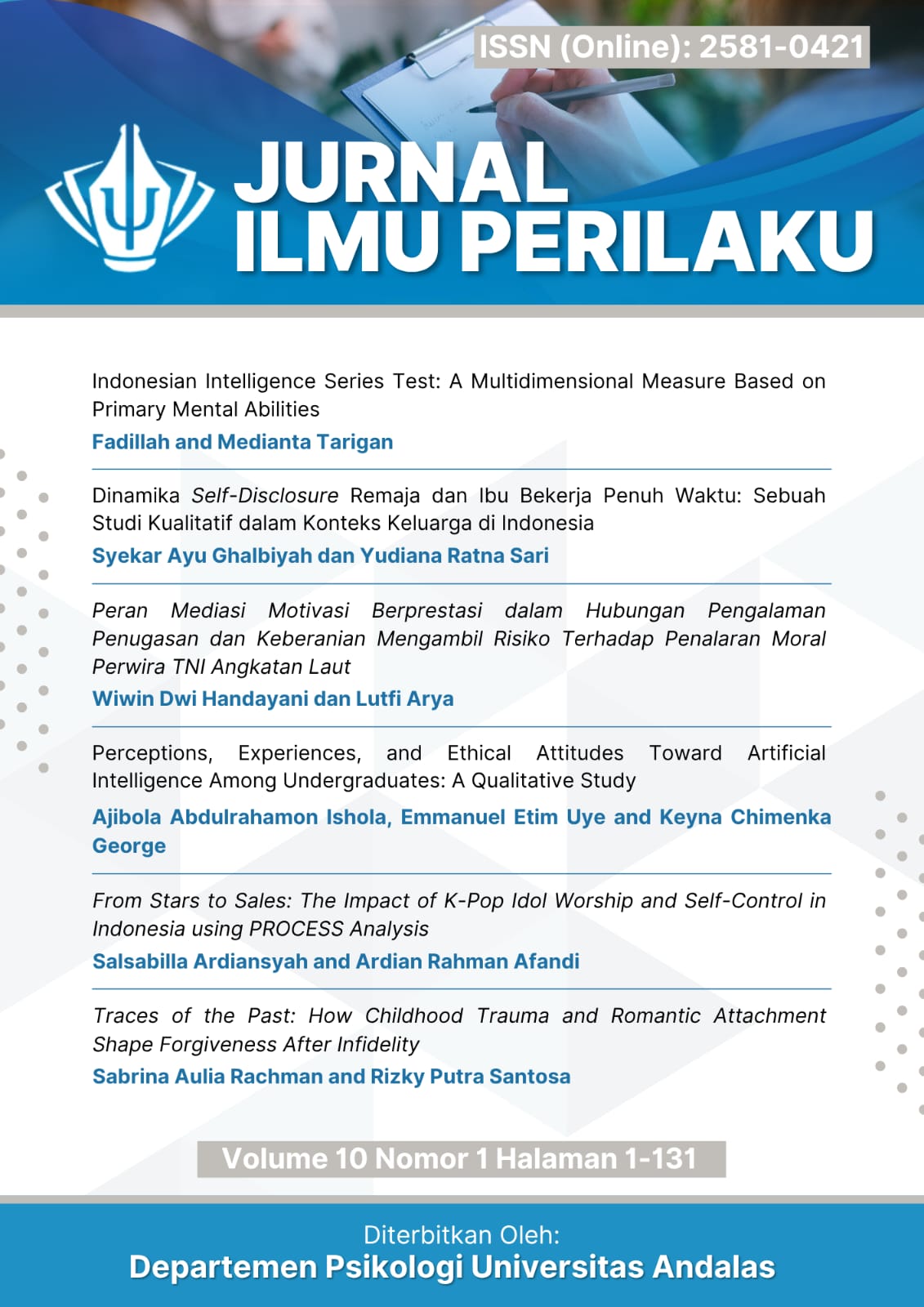
In this volume, we are pleased to present a diverse collection of six articles that reflect the breadth of contemporary psychological research, encompassing intelligence assessment, family relationships, romantic relationships, moral reasoning, artificial intelligence, and consumer behavior. Continuing our commitment to advancing psychological scholarship, this edition brings together empirical investigations that offer insights into human cognition, interpersonal experiences, ethical development, and behavioral patterns across different social and cultural contexts. Through a combination of quantitative and qualitative approaches, the articles in this issue contribute to ongoing discussions in psychology while highlighting the relevance of psychological research to the challenges faced by individuals and communities in an increasingly complex world.
The first article examines the initial psychometric properties of the Indonesian Intelligence Series Test (TSKI), a locally developed instrument designed to assess verbal, numerical, and figural abilities within a hierarchical model of intelligence. The findings supported the proposed hierarchical structure, indicating that the three cognitive ability domains were distinguishable yet related through a higher-order general intelligence factor. The second article explores self- disclosure between adolescents and full-time working mothers. The findings highlight the importance of maternal sensitivity, responsiveness, and assertive communication in fostering positive self-disclosure.
The third article investigates childhood trauma, romantic attachment, and forgiveness after infidelity. The findings revealed that adverse childhood experiences negatively predicted forgiveness, while romantic attachment did not mediate this relationship. The fourth article examines achievement motivation and moral reasoning among Indonesian Navy officers. The findings showed that achievement motivation fully mediated the relationships between assignment experience, risk-taking propensity, and moral reasoning.
The sixth and final article, From Stars to Sales: The Impact of K-Pop Idol Worship and Self-Control in Indonesia Using PROCESS Analysis, investigates the relationship between celebrity worship and consumptive behavior among Indonesian K-pop fans, with particular attention to the potential moderating role of self-control. The findings indicated that self-control did not significantly moderate this relationship. This result challenges assumptions that stronger self-control necessarily weakens the association between celebrity worship and consumption, suggesting that the relationship may involve contextual or psychological factors that warrant further investigation.
The entire Editorial Board of Jurnal Ilmu Perilaku (JIP) extends its sincere gratitude to the authors, reviewers, and all partners who have contributed their time, expertise, and dedication to the publication of this issue. Through their scholarly commitment and voluntary contributions, JIP continues to develop as a platform for academic exchange, critical reflection, and the advancement of psychological science. We hope that the articles presented in this volume will offer valuable insights, stimulate further dialogue, and inspire future research that addresses the diverse psychological challenges faced by individuals and communities.
We also warmly invite researchers, academics, and practitioners to submit their best manuscripts to Jurnal Ilmu Perilaku. We remain committed to supporting the development of psychological scholarship in Indonesia and to fostering meaningful contributions to the broader international research community. We hope that the knowledge shared in this edition will encourage new perspectives, strengthen collaboration, and contribute to the continued advancement of psychology.Please enjoy the read!
Greetings,
Editorial Board of Jurnal Ilmu Perilaku (JIP)
Jurnal Ilmu Perilaku, with registered number ISSN 2581-0421 (online), is a scientific psychological journal published by Program Studi Psikologi Fakultas Kedokteran Universitas Andalas. It is a national journal that covers a lot of commons problems or issues relate to the psychological sciences. The aim of this journal publication is to disseminate the conceptual thoughts or ideas and research results that have been achieved in the area of psychology.
Jurnal Ilmu Perilaku, particularly focuses on the main problems in the development of the Indonesian Psychology areas. It covers Indonesian behaviors in mental health and social context.
Jurnal Ilmu Perilaku publishes 5 -7 articles in each edition with 10 - 18 pages long for each article. One volume of Jurnal Ilmu Perilaku divided into two editions, which are published in the 1st and 2nd semesters each year. Articles are written in Bahasa Indonesia (Indonesian language) OR English. Abstracts must be in English.
Please read these guidelines carefully. Authors who want to submit their manuscript to the editorial office of Jurnal Ilmu Perilaku should obey the writing guidelines. If the manuscript submitted is not appropriate with the guidelines or written in a different format, it will BE REJECTED by the editors before further reviewed. The editors will only accept the manuscripts which meet the assigned format.
In the following year of publication (2017), Jurnal Ilmu Perilaku is going to publish journals twice in two terms: Juni and December. Please submit your manuscript. Please Download the Template HERE. The draft of Publication Ethics and Malpractice Statement can be downloaded at the Publication Ethics and Malpractice Statement Letter link or the following link for document format. Author Fees HERE.
Tools




Indexed By :







ISSN Barcode :