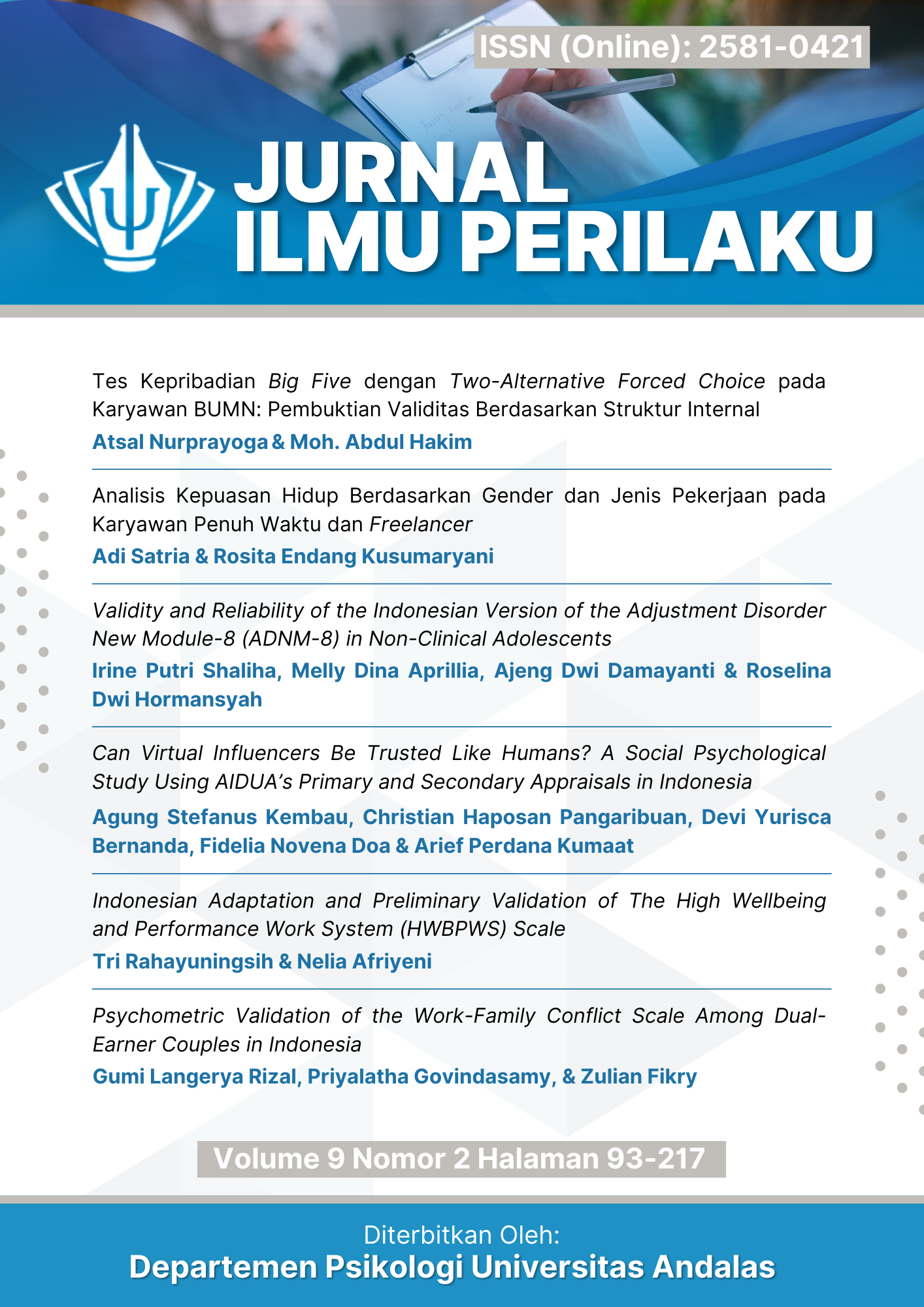
Psychometric Validation of the Work-Family Conflict Scale Among Dual-Earner Couples in Indonesia
DOI:
https://doi.org/10.25077/jip.9.2.197-217.2025Keywords:
Dual-earner couples, Family-to-Work Conflict, Psychometric validity, Work-to-Family Conflict, Work–Family Conflict (WFC) scaleAbstract
Work–Family Conflict (WFC) has been widely examined, yet empirical validation of its measurement remains limited in Indonesia. Many local studies rely on translated instruments without comprehensive psychometric testing, raising concerns about cultural accuracy. This study addresses this gap by validating the bidimensional WFC scale, Work Interference with Family (WIF) and Family Interference with Work (FIW), among 492 dual-earner spouses in Indonesia. The results confirmed strong internal reliability (α > 0.78; CR > 0.85) and adequate convergent validity (AVE > 0.50), supporting a stable two-factor structure in which WIF and FIW emerged as related but distinct constructs. The findings highlight culturally embedded and gendered dynamics of role conflict in Indonesian couples and contribute to cross-cultural work–family research. Practically, the validated instrument provides a reliable tool for researchers and organizations to assess role conflict and develop family-supportive workplace policies.
Downloads
References
Adams, A., & Golsch, K. (2021). Gender-specific patterns and determinants of spillover between work and family: The role of partner support in dual-earner couples. Journal of Family Research, 33(1), 72–98. https://doi.org/10.20377/jfr-373
Allen, T. D. (2012). The Work and Family Interface. In The Oxford Handbook of Organizational Psychology (Vol. 2, Issue July 2018). https://doi.org/10.1093/oxfordhb/9780199928286.013.0034
Allen, T. D., & Finkelstein, L. M. (2014). Work-family conflict among members of full-time dual-earner couples: An examination of family life stage, gender, and age. Journal of Occupational Health Psychology, 19(3), 376–384. https://doi.org/10.1037/a0036941
Allen, T. D., French, K. A., Dumani, S., & Shockley, K. M. (2015). Meta-analysis of work-family conflict mean differences: Does national context matter? Journal of Vocational Behavior, 90, 90–100. https://doi.org/10.1016/j.jvb.2015.07.006
Allen, T. D., Johnson, R. C., Kiburz, K. M., & Shockley, K. M. (2013). Work-Family Conflict and Flexible Work Arrangements: Deconstructing Flexibility. Personnel Psychology, 66(2), 345–376. https://doi.org/10.1111/peps.12012
Beaton, D. E., Bombardier, C., Guillemin, F., & Ferraz, M. B. (2000). Guidelines for the process of cross-cultural adaptation of self-report measures. Spine, 25(24), 3186–3191.
Cerrato, J., & Cifre, E. (2018). Gender inequality in household chores and work-family conflict. Frontiers in Psychology, 9(AUG). https://doi.org/10.3389/fpsyg.2018.01330
Edwards, J. R., & Rothbard, N. P. (2000). Mechanisms Linking Work and Family: Clarifying the Relationship between Work and Family Constructs. The Academy of Management Review, 25(1), 178. https://doi.org/10.2307/259269
Greenhaus, J. H., & Beutell, N. J. (1985). Sources of Conflict between Work and Family Roles. In Source: The Academy of Management Review (Vol. 10, Issue 1). https://www.jstor.org/stable/258214
Hair, J. F., Hult, G. T. M., Ringle, C. M., & Sarstedt, M. (2019). A Primer on Partial Least Squares Structural Equation Modeling (PLS-SEM) (2nd ed.). SAGE Publications.
Kenny, D. A., Kashy, D. A., & Cook, W. L. (2006). Dyadic data analysis. Guilford Press.
Lapierre, L. M., & Allen, T. D. (2012). Control at Work, Control at Home, and Planning Behavior: Implications for Work-Family Conflict. Journal of Management, 38(5), 1500–1516. https://doi.org/10.1177/0149206310385868
Michel, J. S., Kotrba, L. M., Mitchelson, J. K., Clark, M. A., & Baltes, B. B. (2011). Antecedents of work-family conflict: A meta-analytic review. Journal of Organizational Behavior, 32(5), 689–725. https://doi.org/10.1002/job.695
Minnotte, K. L., & Minnotte, M. C. (2018). Work-Family Conflict Among Dual-Earners: Are Partner, Family, and Friends Resources or Liabilities? Journal of Family and Economic Issues, 39(2), 258–276. https://doi.org/10.1007/s10834-017-9561-4
Netemeyer, R. G., Boles, J. S., & McMurrian, R. (1996). Development and validation of work–family conflict and family–work conflict scales. Journal of Applied Psychology, 81(4), 400–410. https://doi.org/10.1037/0021-9010.81.4.400
Rizal, G. L., & Fikry, Z. (2023). PENGARUH WORK FAMILY CONFLICT TERHADAP PARENTING STRESS IBU YANG BEKERJA. https://doi.org/10.24036/rapun.v13i2
Shockley, K. M., & Allen, T. D. (2018). It’s not what I expected: The association between dual-earner couples’ met expectations for the division of paid and family labor and well-being. Journal of Vocational Behavior, 104, 240–260. https://doi.org/10.1016/j.jvb.2017.11.009
Shockley, K. M., Shen, W., DeNunzio, M. M., Arvan, M. L., & Knudsen, E. A. (2017). Disentangling the relationship between gender and work–family conflict: An integration of theoretical perspectives using meta-analytic methods. Journal of Applied Psychology, 102(12), 1601–1635.
Sulastri, R. (2021). Dual-Earner Family Dalam Pandangan Masyarakat Dan Pemahaman Keagamaan Islam. Khazanah Multidisiplin, 3(1), 21–39. https://doi.org/10.15575/kl.v3i1.15808
Wan, M., Shaffer, M. A., Dou, J., Zhang, M., & Zhang, Y. (2022). A Dyadic Approach to Examining Dual-Earner Couples’ Boundary Segmentation Preferences and Work–Family Conflict. International Journal of Stress Management, 29(3), 292–305. https://doi.org/10.1037/str0000262
Wang, X., Zhang, L., Wu, X., & Zhao, M. (2021). Work-Family Conflict, Enrichment, and Adolescent Academic Adjustment in Dual-Earner Family. Frontiers in Psychology, 12. https://doi.org/10.3389/fpsyg.2021.712954
Weeks, A., Swerissen, H., & Belfrage, J. (2007). Issues, challenges, and solutions in translating study instruments. Evaluation Review, 31(2), 153–165. https://doi.org/10.1177/0193841X06294184
Westman, M. (2001). Stress and strain crossover. Human Relations, 54(6), 717–751. https://doi.org/10.1177/0018726701546002
Westman, M., & Etzion, D. (1995). Crossover of stress, strain and resources from one spouse to another. Journal of Organizational Behavior, 16(2), 169–181. https://doi.org/10.1002/job.4030160207
Yang, X., Kong, X., Qian, M., Zhang, X., Li, L., Gao, S., Ning, L., & Yu, X. (2024). The effect of work-family conflict on employee well-being among physicians: the mediating role of job satisfaction and work engagement. BMC Psychology, 12(1), 530. https://doi.org/10.1186/s40359-024-02026-8
Zhang, J. (2016). Work-Family Conflict and Child Well-being : When Work-Family Conflict Really Hits Home.
Downloads
Published
How to Cite
Issue
Section
License
Copyright (c) 2026 Gumi Langerya Rizal, Priyalatha Govindasamy, Zulian Fikry

This work is licensed under a Creative Commons Attribution-NonCommercial-ShareAlike 4.0 International License.
The non-commercial use of the article is governed by the Creative Commons Attribution license as currently displayed on Creative Commons Attribution-NonCommercial-ShareAlike 4.0 International License.
JIP's spirit is to disseminate articles published are as free as possible. Under the Creative Commons license, JIP permits users to copy, distribute, display, and perform the work for non-commercial purposes only. Users will also need to attribute authors and JIP on distributing works in the journal.
Please find the rights and licenses in Jurnal Ilmu Perilaku (JIP).
- License
The non-commercial use of the article will be governed by the Creative Commons Attribution license as currently displayed on Creative Commons Attribution-NonCommercial-ShareAlike 4.0 International License.
- Author’s Warranties
The author warrants that the article is original, written by stated author(s), has not been published before, contains no unlawful statements, does not infringe the rights of others, is subject to copyright that is vested exclusively in the author and free of any third party rights, and that any necessary written permissions to quote from other sources have been obtained by the author(s).
- User Rights
JIP's spirit is to disseminate articles published are as free as possible. Under the Creative Commons license, JIP permits users to copy, distribute, display, and perform the work for non-commercial purposes only. Users will also need to attribute authors and JIP on distributing works in the journal.
- Rights of Authors
Authors retain the following rights:
- Copyright, and other proprietary rights relating to the article, such as patent rights,
- The right to use the substance of the article in future own works, including lectures and books,
- The right to reproduce the article for own purposes, provided the copies are not offered for sale,
- The right to self-archive the article.
- Co-Authorship
If the article was jointly prepared by other authors, the signatory of this form warrants that he/she has been authorized by all co-authors to sign this agreement on their behalf, and agrees to inform his/her co-authors of the terms of this agreement.
- Termination
This agreement can be terminated by the author or JIP upon two months’ notice where the other party has materially breached this agreement and failed to remedy such breach within a month of being given the terminating party’s notice requesting such breach to be remedied. No breach or violation of this agreement will cause this agreement or any license granted in it to terminate automatically or affect the definition of JIP.
- Royalties
This agreement entitles the author to no royalties or other fees. To such extent as legally permissible, the author waives his or her right to collect royalties relative to the article in respect of any use of the article by JIP or its sublicensee.
- Miscellaneous
JIP will publish the article (or have it published) in the journal if the article’s editorial process is successfully completed and JIP or its sublicensee has become obligated to have the article published. JIP may conform the article to a style of punctuation, spelling, capitalization, referencing and usage that it deems appropriate. The author acknowledges that the article may be published so that it will be publicly accessible and such access will be free of charge for the readers.