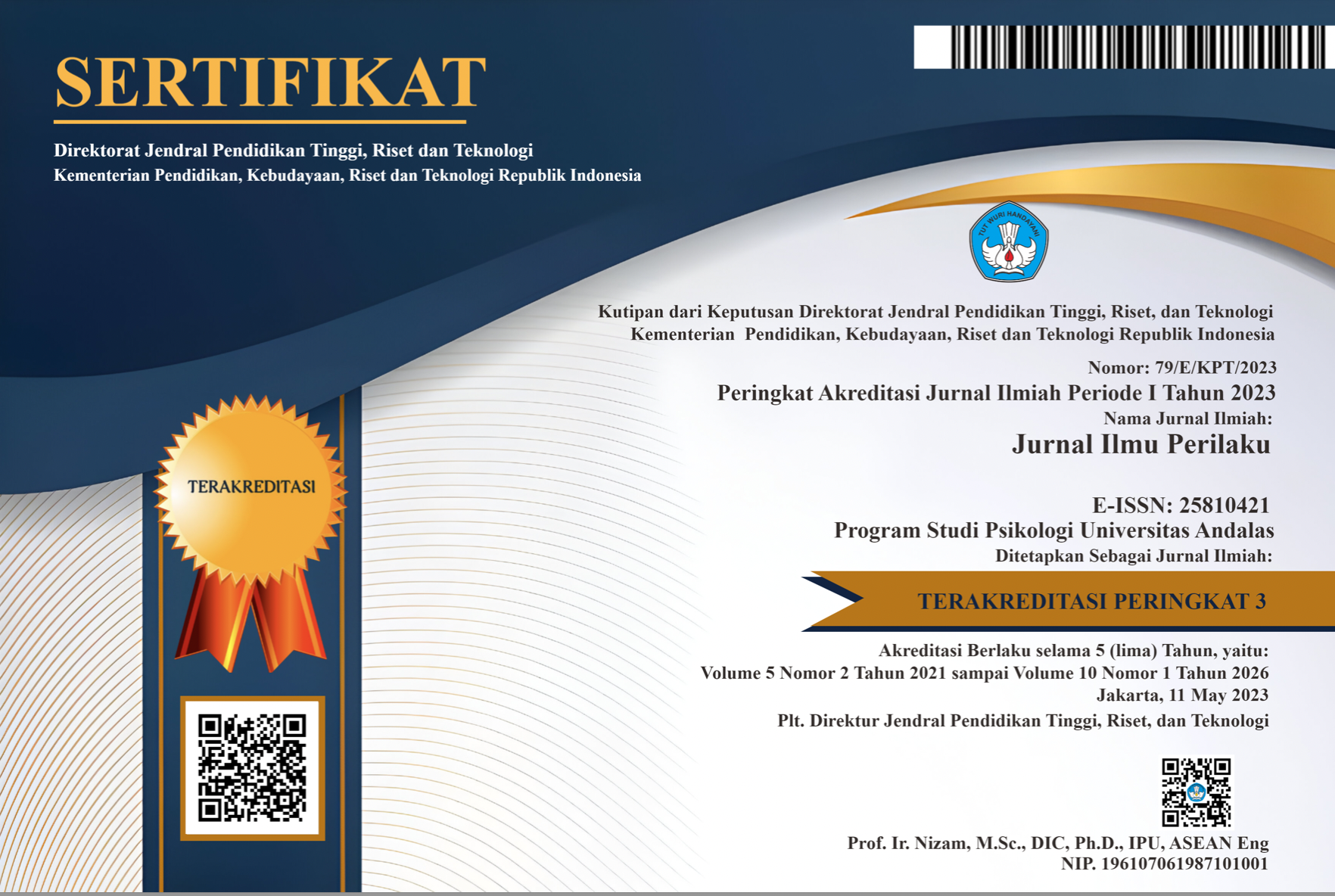
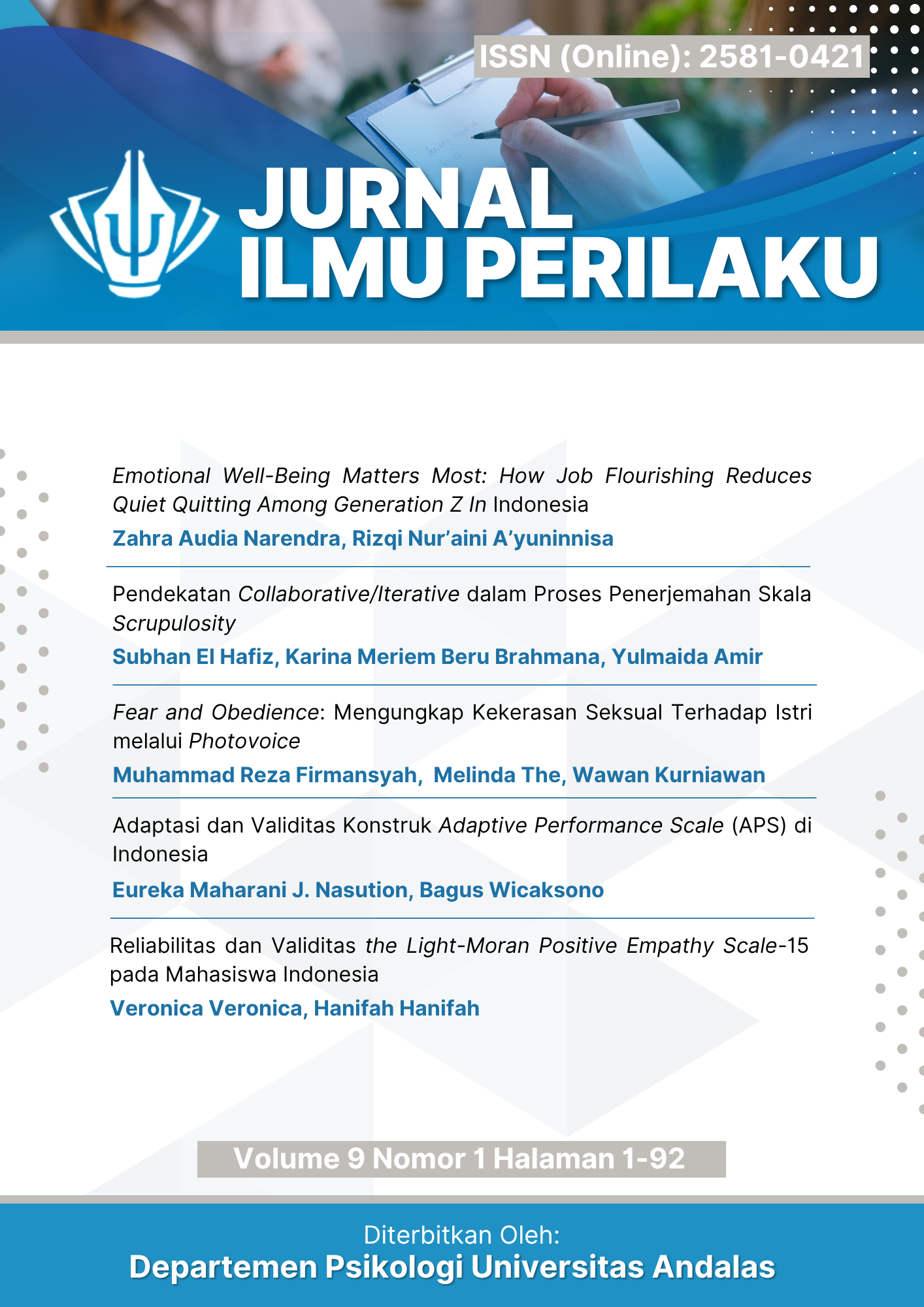
Reliabilitas dan Validitas the Light-Moran Positive Empathy Scale-15 pada Mahasiswa Indonesia
DOI:
https://doi.org/10.25077/jip.9.1.75-92.2025Keywords:
College students, Empathy, Positive EmpathyAbstract
Empathy is a change in emotional state that results from reflecting on the emotional state of others and experiencing an emotional quality similar to the emotions experienced by other people. The Light-Moran Positive Empathy Scale (PES-15) was developed to measure positive emotional responses to others’ emotional expressions. This study aims to adapt Light-Moran PES-15 and test the validity and reliability of the Indonesian version of Light-Moran PES-15. A total of 101 Indonesian students participated by completing the Indonesian version of Light-Moran PES-15. Data were analyzed using descriptive statistics, Cronbach’s alpha, corrected item-total correlation, and CFA. The Cronbach's alpha result = 0.89 with each dimension being 0.79 and 0.83. Item-total correlation = 0.39 – 0.72. CFI = 1.00, TLI = 1.00, NFI = 0.981 RMSEA = 0.00. This shows that this measuring instrument can be trusted and is able to measure the level of positive empathy with the Indonesian student population. This study provides an important contribution to the development of empathy measurement tool in Indonesia.
Downloads
References
Arikunto, S. (2021). Dasar-dasar evaluasi pendidikan (3rd ed.). Bumi Aksara.
Azwar, S. (2016). Penyusunan Skala Psikologi (2nd ed.). Pustaka Belajar.
Indra, A. S. (2018). Statistik Gender Tematik: Profil Generasi Milenial Indonesia. Badan pusat statistik.
Browne, M. W., & Cudeck, R. (1993). Alternative ways of assessing model fit. In K. A. Bollen & J. S. Long (Eds.), Testing structural equation models (pp. 136-162). SAGE Journals.
Chopik, W. J., O’Brien, E., & Konrath, S. H. (2017). Differences in Empathic Concern and Perspective Taking Across 63 Countries. SAGE Journals, 48(1), 23-38.
Di Pellegrino, G., Fadiga, L., Fogassi, L., Gallese, V., & Rizzolatti, G. (1992). Understanding motor events: A neurophysiological study. Experimental Brain Research, 91(1), 176–180. https://doi.org/10.1007/BF00230027
Goldhi. (2025). Maraknya Konten Kreator Sebarkan Berita Negatif, IJTI: Publik Diminta Lebih Kritis. Tvonenews.com. https://www.tvonenews.com/berita/
Hall, J. A., & Schwartz, R. (2019). Empathy present and future. The Journal of Social Psychology, 159(3), 225–243. https://doi.org/10.1080/00224545.2018.1477442
Horan, W. P., Iacoboni, M., Cross, K. A., Korb, A., Lee, J., Nori, P., & Green, M. F. (2014). Self-reported empathy and neural activity during action imitation and observation in schizophrenia. NeuroImage: Clinical, 5, 100-108.
Iacoboni, M. (2009). Imitation, empathy, and mirror neurons. Annual Review of Psychology, 60(1), 653–670. https://doi:10.1146/annurev. Psych.60.110707.163604
Ika, A (2013). Empati Masyarakat Indonesia Sangat Kurang. Universitas Gajah Mada, Kebudayaaan. Yogyakarta: UC UGM.
ITC. (2018). ITC guidelines for translating and adapting tests (second edition). International Journal of Testing, 18(2), 101–134. https://doi.org/10.1080/15305058.2017.1398166
Kanske, P., Böckler, A., Trautwein, F. M., & Singer, T. (2015). Dissecting the social brain: Introducing the EmpaToM to reveal distinct neural networks and brain–behavior relations for empathy and Theory of Mind. NeuroImage, 122, 6-19.
Konrath, S. H., O'Brien, E. H., & Hsing, C. (2011). Changes in dispositional empathy in American college students over time: A meta-analysis. Personality and Social Psychology Review, 15(2), 180-198. 10.1177/1088868310377395
Light, S. N., Coan, J. A., Zahn-Waxler, C., Frye, C., Goldsmith, H. H., and Davidson, R. J. (2009). Empathy is associated with dynamic change in prefrontal brain electrical activity during positive emotion in children. Child Dev. 80, 1210–1231. https://doi.org/10.1111/j.1467-8624.2009.01326.x
Light, S.N, Moran, Z.D, Zahn-Waxler, C and Davidson, R.J. (2019). The Measurement of Positive Valence Forms of Empathy and Their Relation to Anhedonia and Other Depressive Symptomatology. Front. Psychol. 10:815. https://doi.org/10.3389/fpsyg.2019.00815
McCowan, R. J., & McCowan, S. C. (1999). Item Analysis for Criterion-Referenced Tests. ERIC Clearinghouse.
Mirabito, G., Taiwo, Z., Bezdek, M., and Light, S. N. (2019). Fronto-striatal activity predicts anhedonia and positive empathy subtypes. Brain Imaging Behav. https://doi.org/10.1007/s11682-019-00081-z
Morelli, S. A., Lieberman, M. D., & Zaki, J. (2015). The emerging study of positive empathy. Social and Personality Psychology Compass, 9(2), 57-68.
Olii, A. S. (2024). Maraknya konten seksual dan Pelecehan Verbal Tuai Sorotan. Radio Republik Indonesia. https://www.rri.co.id/
Rameson, L. T., & Lieberman, M. D. (2009). Empathy: A social cognitive neuroscience approach. Social and Personality Psychology Compass, 3(1), 94–110. https://doi.org/10.1111/j.1751–9004.2008.00154.x
Sallquist, J., Eisenberg, N., Spinrad, T. L., Eggum, N. D., & Gaertner, B. M. (2009). Assessment of preschoolers’ positive empathy: Concurrent and longitudinal relations with positive emotion, social competence, and sympathy. The Journal of Positive Psychology, 4(3), 223–233. https://doi.org/10.1080/17439760902819444
Tanaka, J. S. (1993). Multifaceted conceptions of fit in structural models. Testing Structural Equation Models, 10–40.
Warokka, M. C., Pasiak, T. F., & Wongkar, D. (2016). Gambaran empati pada mahasiswa fakultas kedokteran Universitas Sam Ratulangi Angkatan 2010. e-Biomedik, 4
Downloads
Published
How to Cite
Issue
Section
License
Copyright (c) 2025 Veronica, Hanifah

This work is licensed under a Creative Commons Attribution-NonCommercial-ShareAlike 4.0 International License.
The non-commercial use of the article is governed by the Creative Commons Attribution license as currently displayed on Creative Commons Attribution-NonCommercial-ShareAlike 4.0 International License.
JIP's spirit is to disseminate articles published are as free as possible. Under the Creative Commons license, JIP permits users to copy, distribute, display, and perform the work for non-commercial purposes only. Users will also need to attribute authors and JIP on distributing works in the journal.
Please find the rights and licenses in Jurnal Ilmu Perilaku (JIP).
- License
The non-commercial use of the article will be governed by the Creative Commons Attribution license as currently displayed on Creative Commons Attribution-NonCommercial-ShareAlike 4.0 International License.
- Author’s Warranties
The author warrants that the article is original, written by stated author(s), has not been published before, contains no unlawful statements, does not infringe the rights of others, is subject to copyright that is vested exclusively in the author and free of any third party rights, and that any necessary written permissions to quote from other sources have been obtained by the author(s).
- User Rights
JIP's spirit is to disseminate articles published are as free as possible. Under the Creative Commons license, JIP permits users to copy, distribute, display, and perform the work for non-commercial purposes only. Users will also need to attribute authors and JIP on distributing works in the journal.
- Rights of Authors
Authors retain the following rights:
- Copyright, and other proprietary rights relating to the article, such as patent rights,
- The right to use the substance of the article in future own works, including lectures and books,
- The right to reproduce the article for own purposes, provided the copies are not offered for sale,
- The right to self-archive the article.
- Co-Authorship
If the article was jointly prepared by other authors, the signatory of this form warrants that he/she has been authorized by all co-authors to sign this agreement on their behalf, and agrees to inform his/her co-authors of the terms of this agreement.
- Termination
This agreement can be terminated by the author or JIP upon two months’ notice where the other party has materially breached this agreement and failed to remedy such breach within a month of being given the terminating party’s notice requesting such breach to be remedied. No breach or violation of this agreement will cause this agreement or any license granted in it to terminate automatically or affect the definition of JIP.
- Royalties
This agreement entitles the author to no royalties or other fees. To such extent as legally permissible, the author waives his or her right to collect royalties relative to the article in respect of any use of the article by JIP or its sublicensee.
- Miscellaneous
JIP will publish the article (or have it published) in the journal if the article’s editorial process is successfully completed and JIP or its sublicensee has become obligated to have the article published. JIP may conform the article to a style of punctuation, spelling, capitalization, referencing and usage that it deems appropriate. The author acknowledges that the article may be published so that it will be publicly accessible and such access will be free of charge for the readers.