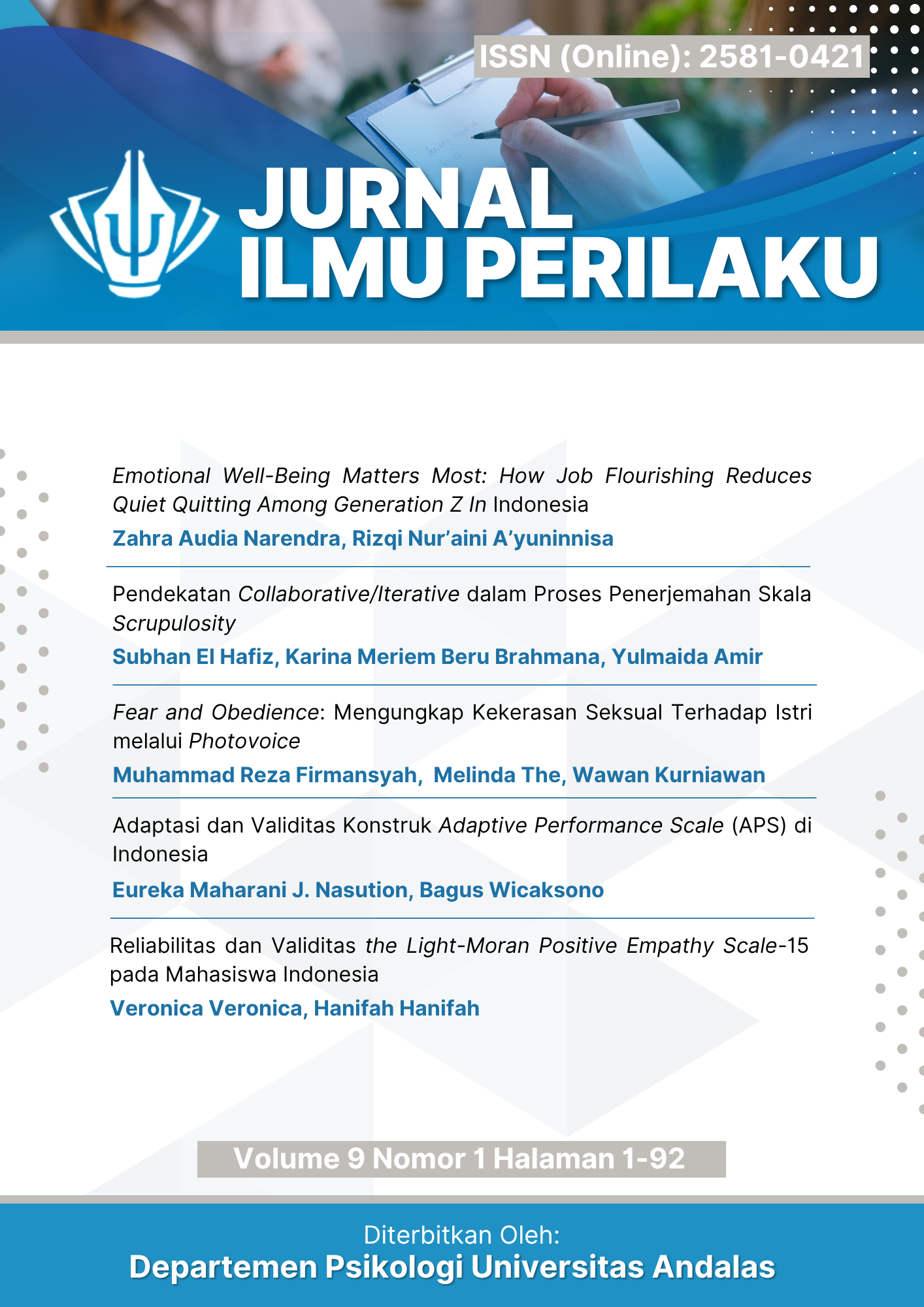
Adaptasi dan Validitas Konstruk Adaptive Performance Scale (APS) di Indonesia
DOI:
https://doi.org/10.25077/jip.9.1.53-74.2025Keywords:
Adaptive Performance, Adaptive Performance Scale, Instrument Adaptation, Reliability, ValidityAbstract
Adaptive performance reflects an individual's ability to adapt to changes in the work environment. Although the Adaptive Performance Scale (APS) has been widely used, no version has been adapted into Indonesian. This study aims to evaluate the validity and reliability of the Adaptive Performance Scale (APS), developed by Charbonnier-Voirin & Roussel (2012) and adapted for use in Indonesia, as a tool for measuring individual adaptive performance within an organizational context. This research was conducted in two studies. In study 1, the translation process and content validity testing involved 4 translators, 5 expert reviewers, and 7 laypeople. Meanwhile, study 2 involved 322 employees in Indonesia (134 males; 188 females) aged between 18-58 years (mean age = 28.9 years; SD = 8.1), using purposive sampling technique. The entire adaptation process referred to the International Test Commission (ITS) Guidelines for Test Adaptation. Confirmatory Factor Analysis (CFA) was utilized to evaluate the measurement model. The results demonstrated that the APS fulfilled the model fit criteria as a multidimensional construct comprising five factors. The APS also demonstrated good reliability. Overall, this study shows that the APS is valid and reliable, making it suitable for measuring adaptive performance in Indonesia.
Downloads
References
Alhija, F. N. A. (2010). Factor Analysis: An Overview and Some Contemporary Advances. Dalam International Encyclopedia of Education. Elsevier.
Artina, B. S., Desnasari, D., Fitriyah, F., & Rizkita, R. G. (2019). The Workforce in Indonesian Organizations: An Analysis Based Upon the Cultural Dimensions of Hofstede’s Model. Journal of International Conference Proceedings, 6(3), 190–201.
Beaton, D. E., Bombardier, C., Guillemin, F., & Ferraz, M. B. (2000). Guidelines for the Process of Cross-Cultural Adaptation of Self-Report Measures. SPINE, 25(24), 3186–3191.
Breu, K., Hemingway, C. J., Strathern, M., & Bridger, D. (2002). Workforce agility: The new employee strategy for the knowledge economy. Journal of Information Technology, 17(1), 21–31. https://doi.org/10.1080/02683960110132070.
Brown, T. A. (2015). Confirmatory Factor Analysis for Applied Research (D. A. Kenny & T. D. Little, Eds.; Second Edition). The Guilford Press. www.guilford.com/MSS.
Charbonnier-Voirin, A., & Roussel, P. (2012). Adaptive performance: A new scale to measure individual performance in organizations. Canadian Journal of Administrative Sciences, 29(3), 280–293. https://doi.org/10.1002/CJAS.232.
Cunningham, J. B., & McCrum-Gardner, E. (2007). Power, effect and sample size using GPower: practical issues for researchers and members of research ethics committees. Evidence Based Midwifery, 5(4), 132–136.
Fridayani, J. A. (2021). Kepemimpinan Adaptif dalam Agilitas Organisasi di Era Adaptasi Kebiasaan Baru. MODUS, 33(2), 138–149.
Furr, R. M., & Bacharach, V. R. (2014). Psychometrics: An introduction. Thousand Oaks, CA, US: Sage Publications, Inc.
Griffin, B., & Hesketh, B. (2003). Adaptable Behaviours for Successful Work and Career Adjustment. Australian Journal of Psychology, 55(2), 65–73. https://doi.org/10.1080/00049530412331312914.
Griffin, M. A., Neal, A., & Parker, S. K. (2007). A New Model of Work Role Performance: Positive Behavior in Uncertain and Interdependent Contexts. Academy of Management Journal, 50(2), 327–347.
Hair, J. F. ., Black, W. C. ., Babin, B. J. ., & Anderson, R. E. . (2014). Multivariate data analysis (7th Edition). Pearson Education Limited.
Hair, J. F., Sarstedt, M., Hopkins, L., & Kuppelwieser, V. G. (2014). Partial least squares structural equation modeling (PLS-SEM): An emerging tool in business research. European Business Review, 26(2), 106–121. https://doi.org/10.1108/EBR-10-2013-0128.
Hendryadi. (2017). Validitas Isi: Tahap Awal Pengembangan Kuesioner. Jurnal Riset Manajemen Dan Bisnis (JRMB) Fakultas Ekonomi UNIAT, 2(2), 169–178.
Hermawanto, A., & Anggraini, M. (2020). Globalisasi, Revolusi Digital dan Lokalitas: Dinamika Internasional dan Domestik di Era Borderless World. LPPM UPN VY Press.
Indiarti, E. D., & Lantu, D. C. (2022). The Impact of Agile Leadership to Business Resilience in the Face of the Vuca Era. Asian Journal of Research in Business and Management, 4(3). https://doi.org/10.55057/ajrbm.2022.4.3.48.
Kementerian Keuangan Republik Indonesia. (2022, 29 September). Prospek Ekonomi di Indonesia Pasca Pandemi. Diakses pada 23 Agustus 2024, melalui https://www.djkn.kemenkeu.go.id/kpknl-kupang/baca-artikel/15468/Prospek-Ekonomi-di-Indonesia-Pasca-Pandemi.html.
Khairi, M. I., Susanti, D., & Sukono. (2021). Study on Structural Equation Modeling for Analyzing Data. International Journal of Ethno-Sciences and Education Research, 1(3), 52–60.
Lynn, M. R. (1986). Determination and Quantification of Content Validity. Nursing Research, 35(6), 382–385.
Muduli, A. (2013). Workforce Agility: A Review of Literature. The IUP Journal of Management Research, XII(3). https://www.researchgate.net/publication/268632467.
Mustafa, Z. B. (2021). Factors Affect Adaptive performance Among Officers at Universiti Malaysia Perlis (UniMAP). Universiti Utara Malaysia (UUM).
Park, S., & Park, S. (2019). Employee Adaptive Performance and Its Antecedents: Review and Synthesis. Human Resource Development Review, 18(3), 294–324. https://doi.org/10.1177/1534484319836315.
Pulakos, E. D., Arad, S., Donovan, M. A., & Plamondon, K. E. (2000). Adaptability in the workplace: Development of a taxonomy of adaptive performance. Journal of Applied Psychology, 85(4), 612–624. https://doi.org/10.1037/0021-9010.85.4.612.
Puspitasari, W. D., & Febrinita, F. (2021). Pengujian Validitas Isi (Content Validity) Angket Persepsi Mahasiswa terhadap Pembelajaran Daring Matakuliah Matematika Komputasi. Focus ACTion Of Research Mathematic, 4(1), 77–90. https://doi.org/10.30762/factor-m.v4i1.3254.
Rahman, M. N., Mona, S. S., & Noman, S. A. Al. (2020). COVID-19, Consumer Behavior and Inventory Management: A Study on the Retail Pharmaceutical Industry of Bangladesh. Supply Chain Insider, 2(4). https://www.researchgate.net/publication/347511824.
Rochmawati, T., & Sucitra, L. (2014). Dinamika Pasar dan Dampaknya terhadap Kegagalan Usaha UMKM: Studi Kasus Pasir Pangaraian. Jurnal Bina Wira, 2(1), 10–18.
Saptarini, N. I., & Mustika, M. D. (2023). Workforce Agility and Adaptive Performance in Government Insititution: The Mediating Role of Work Engagement. Jurnal Manajemen Dan Kewirausahaan, 25(1), 55–62. https://doi.org/10.9744/jmk.25.1.55-62.
Sasongko, E. N., Mustafid, & Rusgiyono, A. (2016). Penerapan Metode Structural Equation Modeling untuk Analisis Kepuasan Pengguna Sistem Informasi Akademik Terhadap Kualitas Website. Jurnal Gaussian, 5(3), 395–404.
Shi, J., Mo, X., & Sun, Z. (2012). Content validity index in scale development. Zhong Nan Da Xue Xue Bao Yi Xue Ban, 37(2), 152–155.
Wheaton, B., Muthén, B., Alwin, D. F., & Summers, G. F. (1977). Assessing Reliability and Stability in Panel Models. Sociological Methodology, 8, 84–136.
Downloads
Published
How to Cite
Issue
Section
License
Copyright (c) 2025 Eureka Maharani J. Nasution, Bagus Wicaksono

This work is licensed under a Creative Commons Attribution-NonCommercial-ShareAlike 4.0 International License.
The non-commercial use of the article is governed by the Creative Commons Attribution license as currently displayed on Creative Commons Attribution-NonCommercial-ShareAlike 4.0 International License.
JIP's spirit is to disseminate articles published are as free as possible. Under the Creative Commons license, JIP permits users to copy, distribute, display, and perform the work for non-commercial purposes only. Users will also need to attribute authors and JIP on distributing works in the journal.
Please find the rights and licenses in Jurnal Ilmu Perilaku (JIP).
- License
The non-commercial use of the article will be governed by the Creative Commons Attribution license as currently displayed on Creative Commons Attribution-NonCommercial-ShareAlike 4.0 International License.
- Author’s Warranties
The author warrants that the article is original, written by stated author(s), has not been published before, contains no unlawful statements, does not infringe the rights of others, is subject to copyright that is vested exclusively in the author and free of any third party rights, and that any necessary written permissions to quote from other sources have been obtained by the author(s).
- User Rights
JIP's spirit is to disseminate articles published are as free as possible. Under the Creative Commons license, JIP permits users to copy, distribute, display, and perform the work for non-commercial purposes only. Users will also need to attribute authors and JIP on distributing works in the journal.
- Rights of Authors
Authors retain the following rights:
- Copyright, and other proprietary rights relating to the article, such as patent rights,
- The right to use the substance of the article in future own works, including lectures and books,
- The right to reproduce the article for own purposes, provided the copies are not offered for sale,
- The right to self-archive the article.
- Co-Authorship
If the article was jointly prepared by other authors, the signatory of this form warrants that he/she has been authorized by all co-authors to sign this agreement on their behalf, and agrees to inform his/her co-authors of the terms of this agreement.
- Termination
This agreement can be terminated by the author or JIP upon two months’ notice where the other party has materially breached this agreement and failed to remedy such breach within a month of being given the terminating party’s notice requesting such breach to be remedied. No breach or violation of this agreement will cause this agreement or any license granted in it to terminate automatically or affect the definition of JIP.
- Royalties
This agreement entitles the author to no royalties or other fees. To such extent as legally permissible, the author waives his or her right to collect royalties relative to the article in respect of any use of the article by JIP or its sublicensee.
- Miscellaneous
JIP will publish the article (or have it published) in the journal if the article’s editorial process is successfully completed and JIP or its sublicensee has become obligated to have the article published. JIP may conform the article to a style of punctuation, spelling, capitalization, referencing and usage that it deems appropriate. The author acknowledges that the article may be published so that it will be publicly accessible and such access will be free of charge for the readers.