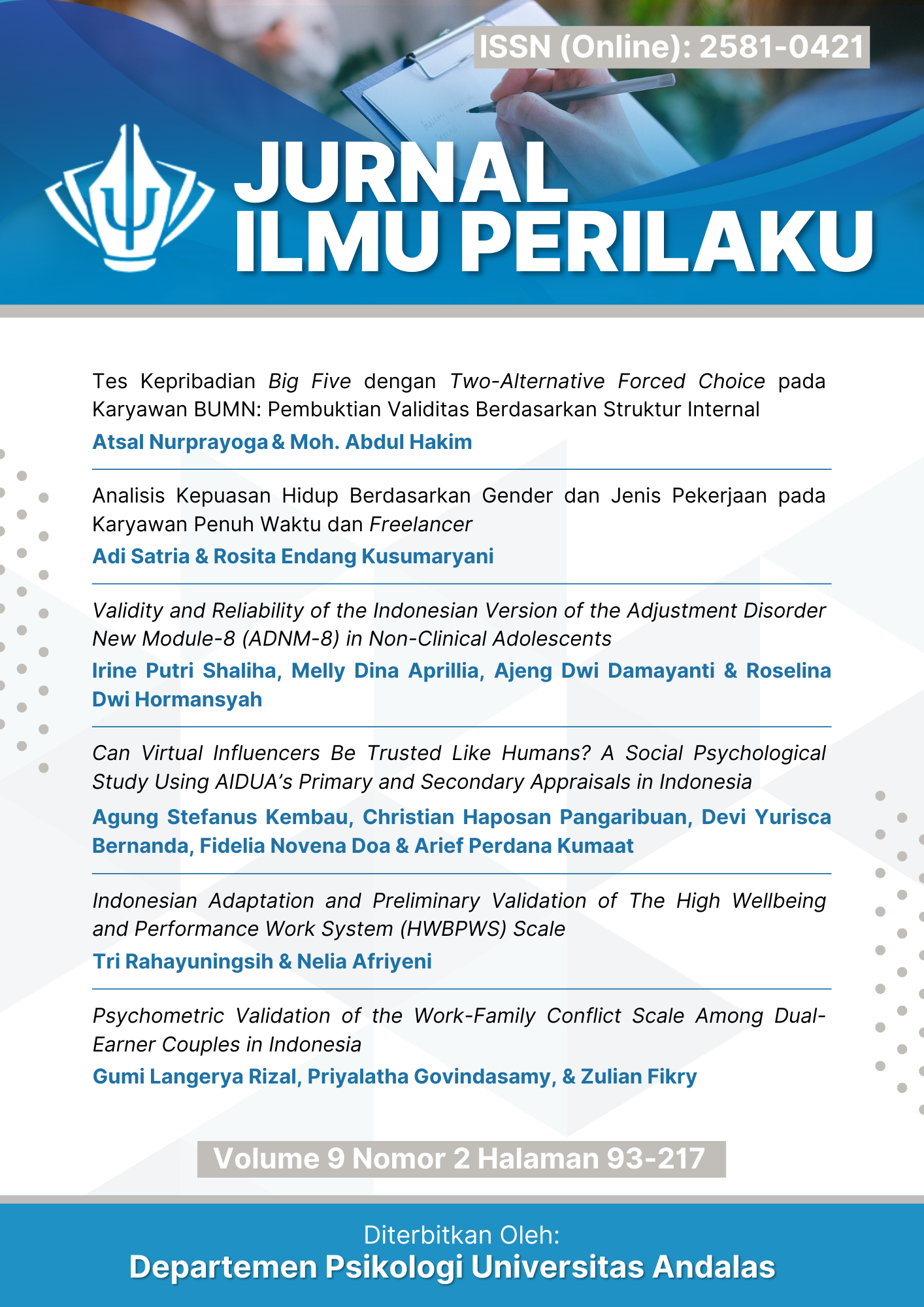
Indonesian Adaptation and Preliminary Validation of The High Wellbeing and Performance Work System (HWBPWS) Scale
DOI:
https://doi.org/10.25077/jip.9.2.172-196.2025Keywords:
HRM, Indonesian, Scale, Validation, WellbeingAbstract
In a competitive workplace, companies are not only required to increase employee productivity but also to ensure their well-being. High-Performance Work Systems (HPWS) have long been used to improve organizational efficiency and performance. However, their implementation is often associated with excessive work pressure, which can negatively impact employee mentality. The urgency of this research stems from the need to develop an integrated HPWS focused on employee well-being, namely the High Well-Being Performance Work Systems (HWBPWS) model. However, existing studies and measurement tools have been developed primarily in Western contexts, raising cultural and contextual concerns for their application in Southeast Asia. This study aims to adapt and validate the HWBPWS scale for the Indonesian workforce. This adaptation followed the International Testing Commission (ITC) guidelines, including translation, expert review, and readability testing. The measurement model was tested using PLS-SEM with the assistance of SmartPLS 4 software. Evaluation of the measurement model included testing convergent validity, internal reliability, and discriminant validity. Data were collected from 123 employees across various industries and analyzed using confirmatory factor analysis. The CFA analysis showed that all items in the final construct had outer loading values above 0.70. In addition, the Cronbach's Alpha and Composite Reliability values for all constructs were above 0.70, and the AVE value exceeded 0.50. Thus, the HWBPWS construct was declared valid and reliable. The results showed that the Indonesian version of the HWBPWS retained 40 fit items across 10 dimensions, with three dimensions removed due to low reliability. All constructs achieved acceptable validity and reliability. These findings provide an evidence-based tool for assessing HR practices that simultaneously improve employee performance and well-being, with important implications for HR management research and practice in Indonesia.
Downloads
Downloads
Published
How to Cite
Issue
Section
License
Copyright (c) 2026 Tri Rahayungngsih, Nelia Afriyeni

This work is licensed under a Creative Commons Attribution-NonCommercial-ShareAlike 4.0 International License.
The non-commercial use of the article is governed by the Creative Commons Attribution license as currently displayed on Creative Commons Attribution-NonCommercial-ShareAlike 4.0 International License.
JIP's spirit is to disseminate articles published are as free as possible. Under the Creative Commons license, JIP permits users to copy, distribute, display, and perform the work for non-commercial purposes only. Users will also need to attribute authors and JIP on distributing works in the journal.
Please find the rights and licenses in Jurnal Ilmu Perilaku (JIP).
- License
The non-commercial use of the article will be governed by the Creative Commons Attribution license as currently displayed on Creative Commons Attribution-NonCommercial-ShareAlike 4.0 International License.
- Author’s Warranties
The author warrants that the article is original, written by stated author(s), has not been published before, contains no unlawful statements, does not infringe the rights of others, is subject to copyright that is vested exclusively in the author and free of any third party rights, and that any necessary written permissions to quote from other sources have been obtained by the author(s).
- User Rights
JIP's spirit is to disseminate articles published are as free as possible. Under the Creative Commons license, JIP permits users to copy, distribute, display, and perform the work for non-commercial purposes only. Users will also need to attribute authors and JIP on distributing works in the journal.
- Rights of Authors
Authors retain the following rights:
- Copyright, and other proprietary rights relating to the article, such as patent rights,
- The right to use the substance of the article in future own works, including lectures and books,
- The right to reproduce the article for own purposes, provided the copies are not offered for sale,
- The right to self-archive the article.
- Co-Authorship
If the article was jointly prepared by other authors, the signatory of this form warrants that he/she has been authorized by all co-authors to sign this agreement on their behalf, and agrees to inform his/her co-authors of the terms of this agreement.
- Termination
This agreement can be terminated by the author or JIP upon two months’ notice where the other party has materially breached this agreement and failed to remedy such breach within a month of being given the terminating party’s notice requesting such breach to be remedied. No breach or violation of this agreement will cause this agreement or any license granted in it to terminate automatically or affect the definition of JIP.
- Royalties
This agreement entitles the author to no royalties or other fees. To such extent as legally permissible, the author waives his or her right to collect royalties relative to the article in respect of any use of the article by JIP or its sublicensee.
- Miscellaneous
JIP will publish the article (or have it published) in the journal if the article’s editorial process is successfully completed and JIP or its sublicensee has become obligated to have the article published. JIP may conform the article to a style of punctuation, spelling, capitalization, referencing and usage that it deems appropriate. The author acknowledges that the article may be published so that it will be publicly accessible and such access will be free of charge for the readers.