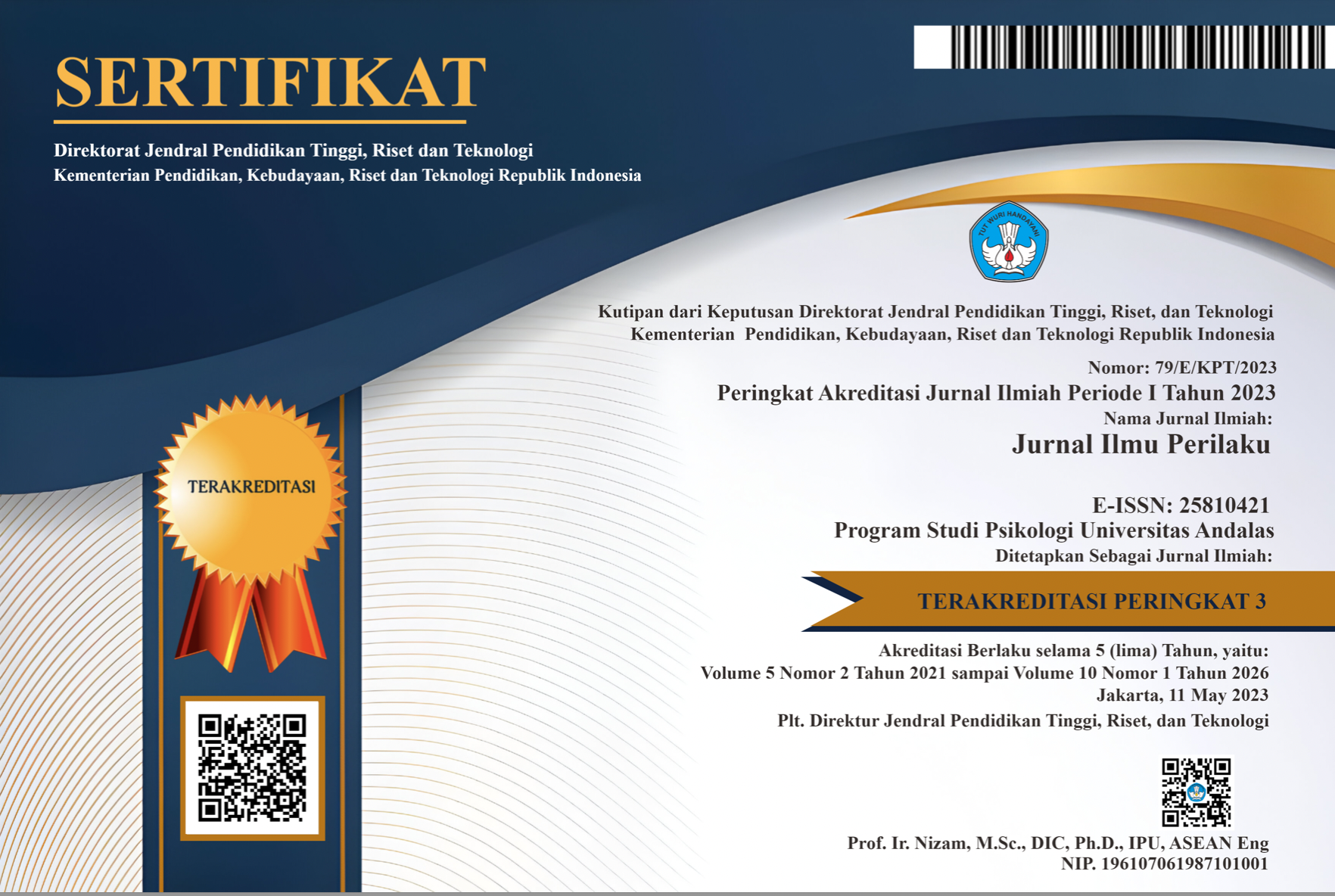
Can Virtual Influencers Be Trusted Like Humans? A Social-Psychological Study in Indonesia
DOI:
https://doi.org/10.25077/jip.9.2.149-171.2025Keywords:
utilitarian collectivism, AIDUA model, anthropomorphism, virtual influencers, social influence, hedonic motivationAbstract
. In Indonesia’s collectivistic yet mobile first marketplace, virtual influencers have evolved from eye catching avatars into algorithmic peers whose persuasive power rests on a blend of social conformity and personal enjoyment. Leveraging the Artificial Intelligence Device Use Acceptance (AIDUA) model, this study isolates primary (cognitive) and secondary (affective) appraisals to explain why users embrace—or recoil from—synthetic personae. A cross sectional online survey of 286 Indonesian social media users (aged 18 35) tested a structural model linking social influence and hedonic motivation to performance expectancy, anthropomorphism to effort expectancy, and both cognitions to discrete positive and negative emotions. Variance based SEM (SmartPLS 4) produced robust psychometrics and significant pathways: social influence (β = .34) and hedonic motivation (β = .46) jointly explained 45 % of performance expectancy, while anthropomorphism sharply reduced perceived effort (β = .61; R² = .38). Performance expectancy amplified positive emotion (β = .48) and effort expectancy mitigated negative emotion (β = −.41), with the model accounting for 42 % of positive and 29 % of negative affect. These results uncover “utilitarian collectivism”—a dual cognitive–affective engine wherein peer validation and hedonic thrill sustain utilitarian value—and position anthropomorphism as a usability heuristic rather than a mere novelty cue.
Downloads
References
Armstrong, J. S., & Overton, T. S. (1977). Estimating nonresponse bias in mail surveys. Journal of Marketing Research, 14(3), 396–402. https://doi.org/10.2307/3150783
Azzahra, J., & Christin, M. (2024). The hyperreality of virtual influencer Lentari Pagi on Instagram. International Journal Software Engineering and Computer Science, 4(1), 165–174. https://ijsecs.ubm.ac.id/index.php/ijsecs/article/view/214 (no DOI)
Belanche, D., Casaló, L. V., & Flavián, M. (2024). Human versus virtual influences: A comparative study. Journal of Business Research, 173, 114493. https://doi.org/10.1016/j.jbusres.2023.114493
Cheng, X., Zhang, X., Cohen, J., & Mou, J. (2022). Human vs. AI: Understanding the impact of anthropomorphism on consumer response to chatbots from the perspective of trust and relationship norms. Information Processing & Management, 59(3), 102940. https://doi.org/10.1016/j.ipm.2021.102940
Chi, N. T. K., & Hoang Vu, N. (2023). Investigating the customer trust in artificial intelligence: The role of anthropomorphism, empathy response, and interaction. CAAI Transactions on Intelligence Technology, 8(1),260–273. https://doi.org/10.1049/cit2.12085
Christanti, C., & Kembau, A. S. (2024). Pengaruh Strategi Pemasaran Konten Dan Afiliasi Terhadap Pembelian Impulsif: Peran Mediasi Pemasaran Viral Dan Kepercayaan. Modus, 36(2), 198-223. https://doi.org/10.24002/modus.v36i2.8787
Chi, O. H., Jia, S., Li, Y., & Gursoy, D. (2021). Developing a formative scale to measure consumers’ trust toward interaction with artificially intelligent (AI) social robots in service delivery. Computers in Human Behavior, 118, 106700. https://doi.org/10.1016/j.chb.2020.106700
Chin, W. W. (1998). The partial least squares approach to structural equation modeling. In G. A. Marcoulides (Ed.), Modern methods for business research (pp. 295–336). Lawrence Erlbaum Associates.
Dabiran, E., Farivar, S., Wang, F., & Grant, G. (2024). Virtually human: Anthropomorphism in virtual influencer marketing. Journal of Retailing and Consumer Services, 79, 103797. https://doi.org/10.1016/j.jretconser.2024.103797
Davlembayeva, D., Chari, S., & Papagiannidis, S. (2025). Virtual influencers in consumer behaviour: A social influence theory perspective. British Journal of Management, 36(1), 202–222. https://doi.org/10.1111/1467-8551.12775
Firellsya, G., Kembau, A. S., Bernanda, D. Y., & Christin, L. (2024). Tren belanja online wanita Gen-Z: Eksplorasi faktor-faktor di balik dominasi wanita Gen-Z pada platform Shopee menggunakan model UTAUT2. Jurnal Informatika Ekonomi Bisnis, 184–196.https://journal.ubm.ac.id/index.php/JIEB/article/view/3286
Fauzi, A. A., & Sheng, M. L. (2021). Ride-hailing apps' continuance intention among different consumer groups in Indonesia: the role of personal innovativeness and perceived utilitarian and hedonic value. Asia Pacific Journal of Marketing and Logistics, 33(5), 1195-1219.
Fornell, C., & Larcker, D. F. (1981). Evaluating structural equation models with unobservable variables and measurement error. Journal of Marketing Research, 18(1), 39–50. https://doi.org/10.2307/3151312
Garson, G. D. (2016). Partial least squares: Regression and structural equation models. Statistical Associates Publishing.
Geisser, S. (1975). The predictive sample reuse method with applications. Journal of the American Statistical Association, 70(350), 320–328. https://doi.org/10.1080/01621459.1975.10479865
Gursoy, D., Chi, O. H., Lu, L., & Nunkoo, R. (2019). Consumer’s acceptance of artificially intelligent (AI) device use in service delivery. International Journal of Information Management, 49, 157–169. https://doi.org/10.1016/j.ijinfomgt.2019.03.008
Hair, J. F., Risher, J. J., Sarstedt, M., & Ringle, C. M. (2019). When to use and how to report the results of PLS-SEM. European Business Review, 31(1), 2–24. https://doi.org/10.1108/EBR-11-2018-0203
Hamby, A., & Jones, N. (2022). The effect of affect: An appraisal theory perspective on emotional engagement in narrative persuasion. Journal of Advertising, 51(1), 116-131.
Henseler, J., Ringle, C. M., & Sarstedt, M. (2015). A new criterion for assessing discriminant validity in variance-based structural equation modeling. Journal of the Academy of Marketing Science, 43(1), 115–135. https://doi.org/10.1007/s11747-014-0403-8
Huwaida, L. A., Yusuf, A., Satria, A. N., Darmawan, M. A., Ammar, M. F., Yanuar, M. W., ... & Yaiprasert, C. (2024). Generation Z and Indonesian Social Commerce: Unraveling key drivers of their shopping decisions. Journal of Open Innovation: Technology, Market, and Complexity, 10(2), 100256.
Jhawar, A., Kumar, P., & Varshney, S. (2023). The emergence of virtual influencers: A shift in the influencer marketing paradigm. Young Consumers, 24(4), 468–484. https://doi.org/10.1108/YC-05-2022-1401
Kembau, A. S., Kolondam, A., & Mandey, N. H. J. (2024). Virtual influencers and digital engagement: Key insights from Indonesia’s younger consumers. Jurnal Manajemen Pemasaran, 18(2), 123–136. https://doi.org/10.9744/pemasaran.18.2.123-136
Kembau, A. S., & Lendo, F. B. (2025, May). Augmented Reality in Fashion and Beauty Product Marketing: A Preliminary Study of Immersive Marketing In Indonesian E-Commerce. In 12th Gadjah Mada International Conference on Economics and Business (GAMAICEB 2024) (pp. 379-395). Atlantis Press. 10.2991/978-94-6463-692-5_20
Kim, E., Shoenberger, H., Kim, D., Thorson, E., & Zihang, E. (2025). Novelty vs. trust in virtual influencers: exploring the effectiveness of human-like virtual influencers and anime-like virtual influencers. International Journal of Advertising, 44(3), 453-483.
Kock, N. (2015). Common method bias in PLS-SEM: A full collinearity assessment approach. International Journal of e-Collaboration, 11(4), 1–10. https://doi.org/10.4018/ijec.2015100101
Laszkiewicz, A., & Kalinska-Kula, M. (2023). Virtual influencers as an emerging marketing theory: A systematic literature review. International Journal of Consumer Studies, 47(6), 2479–2494. https://doi.org/10.1111/ijcs.13044
Longoni, C., & Cian, L. (2022). Artificial intelligence in utilitarian vs. hedonic contexts: The “word-of-machine” effect. Journal of Marketing, 86(1), 91–108. https://doi.org/10.1177/0022242921997084
Downloads
Published
How to Cite
Issue
Section
License
Copyright (c) 2026 Agung Stefanus Kembau, Christian Haposan Pangaribuan, Devi Yurisca Bernanda, Fidelia Novena Doa

This work is licensed under a Creative Commons Attribution-NonCommercial-ShareAlike 4.0 International License.
The non-commercial use of the article is governed by the Creative Commons Attribution license as currently displayed on Creative Commons Attribution-NonCommercial-ShareAlike 4.0 International License.
JIP's spirit is to disseminate articles published are as free as possible. Under the Creative Commons license, JIP permits users to copy, distribute, display, and perform the work for non-commercial purposes only. Users will also need to attribute authors and JIP on distributing works in the journal.
Please find the rights and licenses in Jurnal Ilmu Perilaku (JIP).
- License
The non-commercial use of the article will be governed by the Creative Commons Attribution license as currently displayed on Creative Commons Attribution-NonCommercial-ShareAlike 4.0 International License.
- Author’s Warranties
The author warrants that the article is original, written by stated author(s), has not been published before, contains no unlawful statements, does not infringe the rights of others, is subject to copyright that is vested exclusively in the author and free of any third party rights, and that any necessary written permissions to quote from other sources have been obtained by the author(s).
- User Rights
JIP's spirit is to disseminate articles published are as free as possible. Under the Creative Commons license, JIP permits users to copy, distribute, display, and perform the work for non-commercial purposes only. Users will also need to attribute authors and JIP on distributing works in the journal.
- Rights of Authors
Authors retain the following rights:
- Copyright, and other proprietary rights relating to the article, such as patent rights,
- The right to use the substance of the article in future own works, including lectures and books,
- The right to reproduce the article for own purposes, provided the copies are not offered for sale,
- The right to self-archive the article.
- Co-Authorship
If the article was jointly prepared by other authors, the signatory of this form warrants that he/she has been authorized by all co-authors to sign this agreement on their behalf, and agrees to inform his/her co-authors of the terms of this agreement.
- Termination
This agreement can be terminated by the author or JIP upon two months’ notice where the other party has materially breached this agreement and failed to remedy such breach within a month of being given the terminating party’s notice requesting such breach to be remedied. No breach or violation of this agreement will cause this agreement or any license granted in it to terminate automatically or affect the definition of JIP.
- Royalties
This agreement entitles the author to no royalties or other fees. To such extent as legally permissible, the author waives his or her right to collect royalties relative to the article in respect of any use of the article by JIP or its sublicensee.
- Miscellaneous
JIP will publish the article (or have it published) in the journal if the article’s editorial process is successfully completed and JIP or its sublicensee has become obligated to have the article published. JIP may conform the article to a style of punctuation, spelling, capitalization, referencing and usage that it deems appropriate. The author acknowledges that the article may be published so that it will be publicly accessible and such access will be free of charge for the readers.