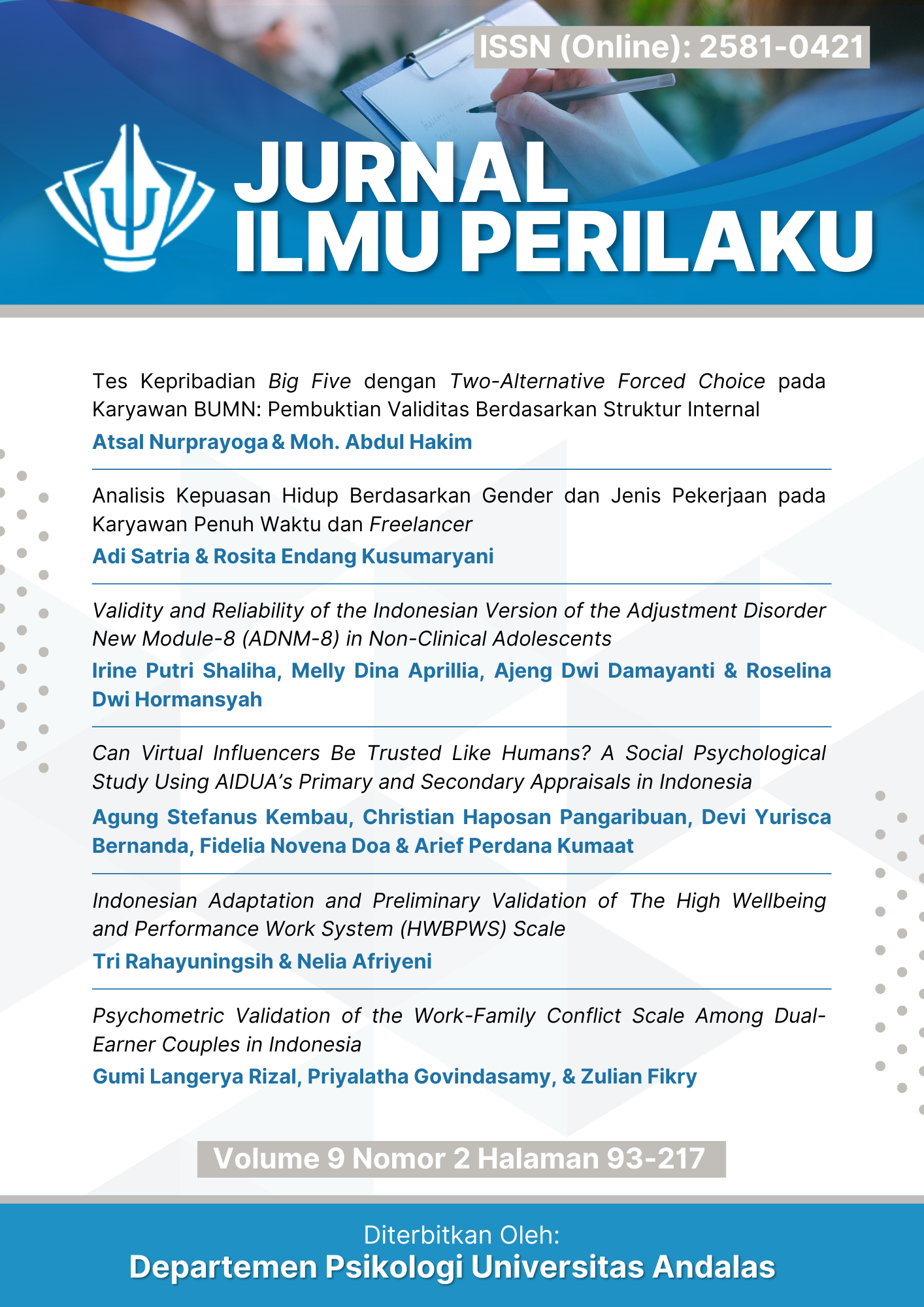
Validity and Reliability of the Indonesian ADNM-8 in Nonclinical Adolescents
DOI:
https://doi.org/10.25077/jip.9.2.131-148.2025Keywords:
adjustment disorder, ADNM-8, Instrument Adaptation, reliability, validityAbstract
Adjustment Disorder (AjD) is a prevalent yet understudied mental health condition among adolescents, particularly in non-Western contexts. Despite its clinical relevance, validated instruments for assessing AjD in Indonesian youth are limited. This study aimed to evaluate the reliability and construct validity of the Indonesian version of the Adjustment Disorder New Module-8 (ADNM-8) as a screening tool for adolescents. Using stratified random sampling, 494 adolescents aged 11–18 years from urban areas in Java, Indonesia, were recruited. Participants were school-attending adolescents who had experienced at least one significant life stressor. The adaptation process included forward translation, expert-based content validation, and back translation to ensure linguistic and conceptual equivalence. Psychometric evaluation involved internal consistency analysis using Cronbach’s alpha and confirmatory factor analysis (CFA) with the DWLS estimator to accommodate ordinal data. The Indonesian ADNM-8 demonstrated strong internal consistency (α = 0.890). CFA results showed good incremental model fit (CFI = 0.965; TLI = 0.951), although RMSEA was elevated (0.143), indicating a limitation possibly related to model complexity. Overall, the findings support the Indonesian ADNM-8 as a reliable and valid screening instrument for AjD in adolescent populations.
Downloads
References
Agarwal, M., Sharma, P., Goswami, A., & Mittal, R. (2024). A 2023 nationwide study on adjustment disorder among first year MBBS students in India. Bioinformation, 20(2), 190–195. https://doi.org/10.6026/973206300200190
Alvarado, C. (2021). Adjustment disorder in the pediatric population. Pediatric Medicine. https://pm.amegroups.org/article/view/6133/html
American Psychiatric Association. (2013). Diagnostic and statistical manual of mental disorders (5th ed.). American Psychiatric Publishing.
American Psychological Association. (2002). Developing Adolescents: A Reference for Professionals. https://www.apa.org/pi/families/resources/develop.pdf
Arnett, J. J. (2000). Emerging adulthood: A theory of development from the late teens through the twenties. American Psychologist, 55(5), 469–480. https://doi.org/10.1037/0003-066X.55.5.469
Ben-Ezra, M., Mahat-Shamir, M., Lorenz, L., Lavenda, O., & Maercker, A. (2018). Screening of adjustment disorder: Scale based on the ICD-11 and the Adjustment Disorder New Module. Journal of psychiatric research, 103, 91–96. https://doi.org/10.1016/j.jpsychires.2018.05.011
Bley, S., Einsle, F., Maercker, A., Weidner, K., & Joraschky, P. (2008). Anpassungsstörungen--Die Erprobung eines neuen diagnostischen Konzepts in einem ambulanten psychosomatischen Setting [Evaluation of a new concept for diagnosing adjustment disorders in a psychosomatic setting]. Psychotherapie, Psychosomatik, medizinische Psychologie, 58(12), 446–453. https://doi.org/10.1055/s-2007-986294
Browne, M. W., & Cudeck, R. (1993). Alternative ways of assessing model fit. Sociological Methods & Research, 21(2), 230–258. https://doi.org/10.1177/0049124193021002005
Caro-Cañizares, I., Sánchez-Colorado, N., Baca-García, E., & Carballo, J. J. (2024). Perceived Stressful Life Events and Suicide Risk in Adolescence: The Mediating Role of Perceived Family Functioning. Behavioral sciences (Basel, Switzerland), 14(1), 35. https://doi.org/10.3390/bs14010035
Carta, M. G., Balestrieri, M., Murru, A., & Hardoy, M. C. (2009). Adjustment disorder: Epidemiology, diagnosis and treatment. Clinical Practice and Epidemiology in Mental Health, 5, Article 15. https://doi.org/10.1186/1745-0179-5-15
Casey P. (2014). Adjustment disorder: new developments. Current psychiatry reports, 16(6), 451. https://doi.org/10.1007/s11920-014-0451-2
Einsle, F., Köllner, V., Dannemann, S., & Maercker, A. (2010). Development and validation of a self-report for the assessment of adjustment disorders. Psychology, health & medicine, 15(5), 584–595. https://doi.org/10.1080/13548506.2010.487107
Glaesmer, H., Romppel, M., Brähler, E., Hinz, A., & Maercker, A. (2015). Adjustment disorder as proposed for ICD-11: Dimensionality and symptom differentiation. Psychiatry research, 229(3), 940–948. https://doi.org/10.1016/j.psychres.2015.07.010
Guo, H. B., & Qiu, C. (2024). How do stressful life events affect medical students' academic adjustment? Parallel mediating mechanisms of anxiety and depression. BMC medical education, 24(1), 617. https://doi.org/10.1186/s12909-024-05601-0
Harris, B. E., Rice, K., Murray, C. V., & Thorsteinsson, E. B. (2023). Validation of the brief Adjustment Disorder New Modules with Australian oncology patients. BioPsychoSocial medicine, 17(1), 2. https://doi.org/10.1186/s13030-022-00259-w
Howarth, E. J., O'Connor, D. B., Panagioti, M., Hodkinson, A., Wilding, S., & Johnson, J. (2020). Are stressful life events prospectively associated with increased suicidal ideation and behaviour? A systematic review and meta-analysis. Journal of affective disorders, 266, 731–742. https://doi.org/10.1016/j.jad.2020.01.171
Hu, L. T., & Bentler, P. M. (1999). Cutoff criteria for fit indexes in covariance structure analysis: Conventional criteria versus new alternatives. Structural Equation Modeling: A Multidisciplinary Journal, 6(1), 1–55. https://doi.org/10.1080/10705519909540118
Kazlauskas, E., Gegieckaite, G., Eimontas, J., Zelviene, P., & Maercker, A. (2018). A Brief Measure of the International Classification of Diseases-11 Adjustment Disorder: Investigation of Psychometric Properties in an Adult Help-Seeking Sample. Psychopathology, 51(1), 10–15. https://doi.org/10.1159/000484415
Kendler, K. S., & Gardner, C. O. (2016). Stressful life events and major depression: Risk period, long-term contextual threat, and diagnostic specificity. The Journal of Nervous and Mental Disease, 204(3), 225–231. https://doi.org/10.1097/NMD.0000000000000474
Kenny, D. A., Kaniskan, B., & McCoach, D. B. (2015). The performance of RMSEA in models with small degrees of freedom. Sociological Methods & Research, 44(3), 486–507. https://doi.org/10.1177/0049124114543236
Lee, P., Lang, J. M., Bodley, M., Vanderploeg, J. J., & Marshall, T. (2023). The Prevalence and Treatment of Adjustment Disorders Among Children at Outpatient Mental Health Clinics. Evidence-Based Practice in Child and Adolescent Mental Health, 9(4), 499–511. https://doi.org/10.1080/23794925.2023.2292035
Lorenz, L., Hyland, P., Perkonigg, A., & Maercker, A. (2018). Is adjustment disorder unidimensional or multidimensional? Implications for ICD-11. International journal of methods in psychiatric research, 27(1), e1591. https://doi.org/10.1002/mpr.1591
Lynn, M. R. (1986). Determination and quantification of content validity. Nursing Research, 35(6), 382–385.
Maercker, A., & Lorenz, L. (2018). Adjustment disorders: Diagnostic conceptualizations and implications for prevention and treatment. Clinical Psychology: Science and Practice, 25(3), e12240.
Maercker, A., Brewin, C. R., Bryant, R. A., Cloitre, M., van Ommeren, M., Jones, L. M., Humayan, A., Kagee, A., Llosa, A. E., Rousseau, C., Somasundaram, D. J., Souza, R., Suzuki, Y., Weissbecker, I., Wessely, S. C., First, M. B., & Reed, G. M. (2013). Diagnosis and classification of disorders specifically associated with stress: proposals for ICD-11. World psychiatry : official journal of the World Psychiatric Association (WPA), 12(3), 198–206. https://doi.org/10.1002/wps.20057
Maercker, A., Einsle, F., & Kollner, V. (2007). Adjustment disorders as stress response syndromes: a new diagnostic concept and its exploration in a medical sample. Psychopathology, 40(3), 135–146. https://doi.org/10.1159/000099290
Maercker, A., Forstmeier, S., Pielmaier, L., et al. (2012). Adjustment disorders: Prevalence in a representative nationwide survey in Germany. Social Psychiatry and Psychiatric Epidemiology, 47(11), 1745–1752.
Maya, J., Lorence, B., Hidalgo, V., & Jiménez, L. (2018). The Role of Psychosocial Stress on a Family-Based Treatment for Adolescents with Problematic Behaviors. International journal of environmental research and public health, 15(9), 1867. https://doi.org/10.3390/ijerph15091867
Monroe, S. M., & Slavich, G. M. (2020). Psychosocial stress and health: Review and integration. Annual Review of Clinical Psychology, 16, 477–501. https://doi.org/10.1146/annurev-clinpsy-050718-095428
Munir, A., Hidayat, R., & Rahmawati, A. (2020). Academic stress factors among Indonesian students: A case of IAIN Batu Sangkar. International Journal of Educational Review, Law and Social Sciences (IJERLAS), 1(1), 1–10. https://doi.org/10.54443/ijerlas.v1i1.3
Newcorn, J. H., & Strain, J. (1992). Adjustment disorder in children and adolescents. Journal of the American Academy of Child & Adolescent Psychiatry, 31(2), 318–326. https://doi.org/10.1097/00004583-199203000-00026
Nunnally, J. C., & Bernstein, I. H. (1994). Psychometric theory (3rd ed.). McGraw-Hill.
Nurius, P. S., & Norris, F. H. (2017). Life stressors and adult mental health: Measurement and conceptual issues. Clinical Psychology Review, 54, 55–67. https://doi.org/10.1016/j.cpr.2017.03.005
Santrock, J. W. (2019). Adolescence (17th ed.). McGraw-Hill Education.
Schermelleh-Engel, K., Moosbrugger, H., & Müller, H. (2003). Evaluating the fit of structural equation models: Tests of significance and descriptive goodness-of-fit measures. Methods of Psychological Research Online, 8(2), 23–74.
Shevlin, M., Hyland, P., & Elklit, A. (2020). Adjustment disorder as a maladaptive stress response syndrome: A conceptual and empirical update. European Journal of Psychotraumatology, 11(1), 1772890.
Sisk, C. L., & Gee, D. G. (2022). Stress and adolescence: Vulnerability and opportunity during a sensitive window of development. Current Opinion in Psychology, 44, 1-6. https://doi.org/10.1016/j.copsyc.2021.08.020
Tavakol, M., & Dennick, R. (2011). Making sense of Cronbach's alpha. International Journal of Medical Education, 2, 53–55. https://doi.org/10.5116/ijme.4dfb.8dfd
World Health Organization. (2018). International classification of diseases for mortality and morbidity statistics (11th revision). Retrieved March 20, 2025, from https://icd.who.int/browse11/l-m/en
Yıldız M. (2020). Stressful life events and adolescent suicidality: An investigation of the mediating mechanisms. Journal of adolescence, 82, 32–40. https://doi.org/10.1016/j.adolescence.2020.05.006
Zelviene, P., & Kazlauskas, E. (2018). Adjustment disorder: current perspectives. Neuropsychiatric disease and treatment, 14, 375–381. https://doi.org/10.2147/NDT.S121072
Zelviene, P., Kazlauskas, E., & Maercker, A. (2020). Risk factors of ICD-11 adjustment disorder in the Lithuanian general population exposed to life stressors. European journal of psychotraumatology, 11(1), 1708617. https://doi.org/10.1080/20008198.2019.1708617
Zhao, N., et al. (2023). School bullying results in poor psychological conditions: Evidence from a survey of 95,545 subjects. arXiv preprint arXiv:2306.06552. https://arxiv.org/abs/2306.06552
Downloads
Published
How to Cite
Issue
Section
License
Copyright (c) 2026 Irine Putri Shaliha, Melly Dina Aprillia, Ajeng Dwi Damayanti, Roselina Dwi Hormansyah

This work is licensed under a Creative Commons Attribution-NonCommercial-ShareAlike 4.0 International License.
The non-commercial use of the article is governed by the Creative Commons Attribution license as currently displayed on Creative Commons Attribution-NonCommercial-ShareAlike 4.0 International License.
JIP's spirit is to disseminate articles published are as free as possible. Under the Creative Commons license, JIP permits users to copy, distribute, display, and perform the work for non-commercial purposes only. Users will also need to attribute authors and JIP on distributing works in the journal.
Please find the rights and licenses in Jurnal Ilmu Perilaku (JIP).
- License
The non-commercial use of the article will be governed by the Creative Commons Attribution license as currently displayed on Creative Commons Attribution-NonCommercial-ShareAlike 4.0 International License.
- Author’s Warranties
The author warrants that the article is original, written by stated author(s), has not been published before, contains no unlawful statements, does not infringe the rights of others, is subject to copyright that is vested exclusively in the author and free of any third party rights, and that any necessary written permissions to quote from other sources have been obtained by the author(s).
- User Rights
JIP's spirit is to disseminate articles published are as free as possible. Under the Creative Commons license, JIP permits users to copy, distribute, display, and perform the work for non-commercial purposes only. Users will also need to attribute authors and JIP on distributing works in the journal.
- Rights of Authors
Authors retain the following rights:
- Copyright, and other proprietary rights relating to the article, such as patent rights,
- The right to use the substance of the article in future own works, including lectures and books,
- The right to reproduce the article for own purposes, provided the copies are not offered for sale,
- The right to self-archive the article.
- Co-Authorship
If the article was jointly prepared by other authors, the signatory of this form warrants that he/she has been authorized by all co-authors to sign this agreement on their behalf, and agrees to inform his/her co-authors of the terms of this agreement.
- Termination
This agreement can be terminated by the author or JIP upon two months’ notice where the other party has materially breached this agreement and failed to remedy such breach within a month of being given the terminating party’s notice requesting such breach to be remedied. No breach or violation of this agreement will cause this agreement or any license granted in it to terminate automatically or affect the definition of JIP.
- Royalties
This agreement entitles the author to no royalties or other fees. To such extent as legally permissible, the author waives his or her right to collect royalties relative to the article in respect of any use of the article by JIP or its sublicensee.
- Miscellaneous
JIP will publish the article (or have it published) in the journal if the article’s editorial process is successfully completed and JIP or its sublicensee has become obligated to have the article published. JIP may conform the article to a style of punctuation, spelling, capitalization, referencing and usage that it deems appropriate. The author acknowledges that the article may be published so that it will be publicly accessible and such access will be free of charge for the readers.