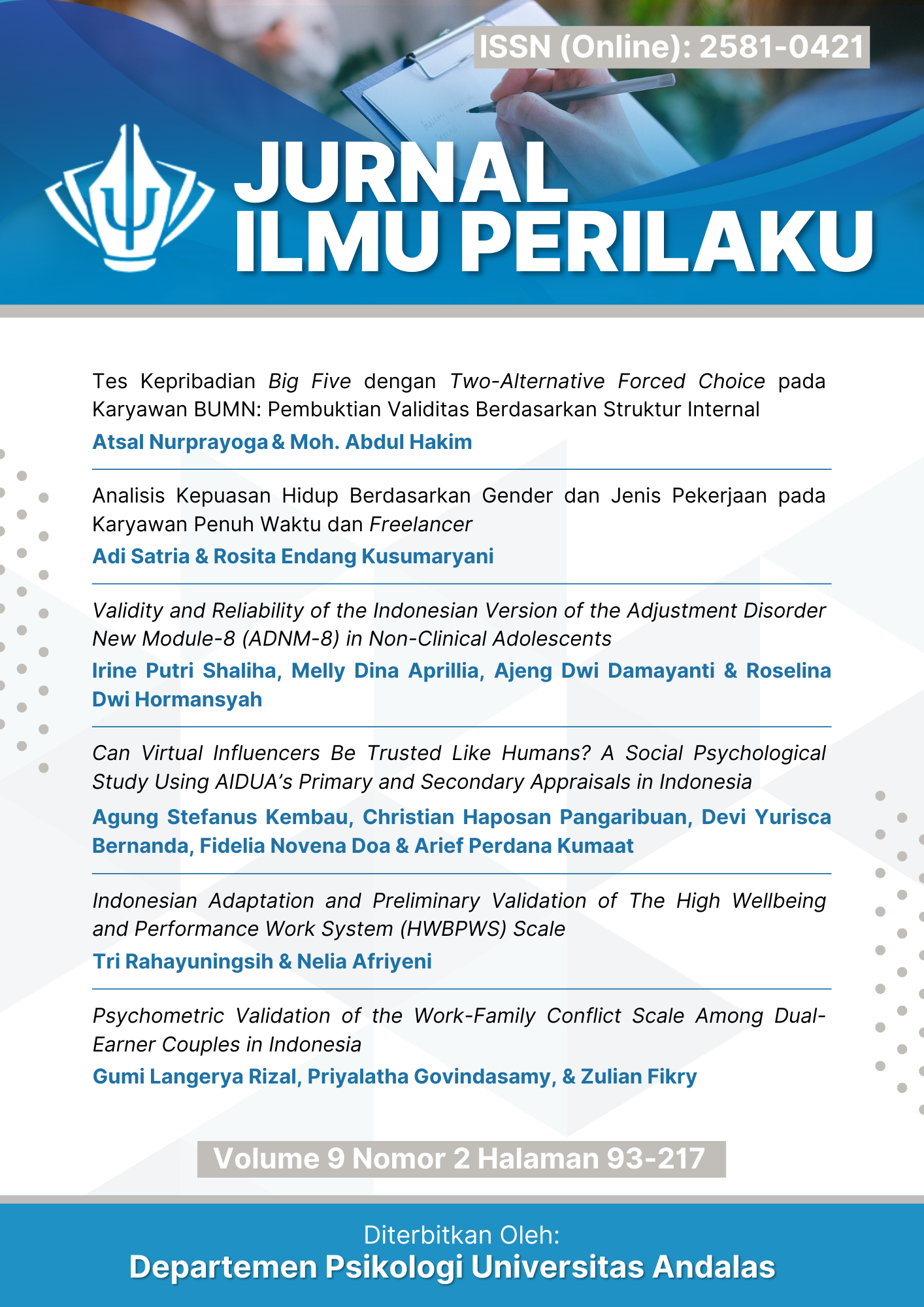
Analisis Kepuasan Hidup Berdasarkan Gender dan Jenis Pekerjaan pada Karyawan Penuh Waktu dan Freelancer
DOI:
https://doi.org/10.25077/jip.9.2.113-130.2025Abstract
The transformation of work patterns in the era of the gig economy has introduced new dynamics into the labor market, influencing how individuals perceive life satisfaction and overall well-being. This phenomenon reflects a growing preference between stable full-time employment and the flexibility of freelance work. While many studies on well-being have emphasized economic or workplace factors, limited research has examined how employment type and gender shape differences in life satisfaction, particu larly in the Indonesian context. Addressing this gap is crucial for developing inclusive labor policies that support diverse worker experiences. Therefore, this study aims to explore differences in life satisfaction between full-time employees and freelancers, as well as the role of gender in influencing these differences. Data were collected from 200 workers in the Greater Jakarta area (102 full-time, 98 freelancers) and analyzed using the Satisfaction with Life Scale (SWLS), independent sample t-test, and two-way ANOVA. The results indicate no significant difference in life satisfaction between employment types (p = .103), suggesting that flexibility provides benefits across both groups. However, female workers reported higher life satisfaction (p = .001), supported by their ability to manage work–life balance and stronger social support. No significant interaction effects were found between gender and employment type (p = .247). These findings highlight that subjective work experiences have stronger effects on life satisfaction than demographic characteristics. This research contributes to the literature on the gig economy, gender studies, and well-being, while offering practical recommendations for organizations to design inclusive policies that enhance worker welfare across employment types.
Downloads
References
Abrar, M., Rehman, Z., Usman, M., & Ullah, N. (2021). Freelancing as an alternative market for software professionals in Pakistan. Vfast Transactions on Software Engineering, 9(3), 78–92. https://doi.org/10.21015/vtse.v9i3.650
Acosta-González, N., & Gutiérrez, Ó. (2023). Bad jobs versus good jobs: Does it matter for life and job satisfaction?. Journal of the Knowledge Economy, 15(2), 7647–7671. https://doi.org/10.1007/s13132-023-01128-9
Amissah, E., Bempong, V., & Gamor, E. (2020). Does gender exacerbate the effect of work-family conflict on employee satisfaction in the hotel industry?. African Journal of Hospitality and Tourism Management, 2(2), 61–81. https://doi.org/10.47963/ajthm.v2i2.245
Badran, L., Rosenbaum, S., & Rimmerman, A. (2023). Quality of life for people with psychiatric disabilities employed in extended employment programs in two Arab towns in Israel: An exploratory study. Frontiers in Psychiatry, 14. https://doi.org/10.3389/fpsyt.2023.1307726
Becchetti, L., & Conzo, G. (2021). The gender life satisfaction/depression paradox. Social Indicators Research, 160(1), 35–113. https://doi.org/10.1007/s11205-021-02740-5
Bloom, N., Liang, J., Roberts, J., & Ying, Z. J. (2015). Does working from home work? Evidence from a Chinese experiment. The Quarterly Journal of Economics, 130(1), 165–218. https://doi.org/10.1093/qje/qju032
Cacanindin, N. (2022). The effects of cultural and social norms, government programs, and digital technologies support Filipino online freelancers' job and career satisfaction. International Journal of Research Publications, 109(1). https://doi.org/10.47119/ijrp1001091920223890
Chen, J., Jing, C., Keasey, K., Lim, I., & Xu, B. (2023). Gender, workplace preferences and firm performance: Looking through the glass door. European Financial Management, 30(1), 403–439. https://doi.org/10.1111/eufm.12421
Downloads
Published
How to Cite
Issue
Section
License
Copyright (c) 2026 Adi Satria

This work is licensed under a Creative Commons Attribution-NonCommercial-ShareAlike 4.0 International License.
The non-commercial use of the article is governed by the Creative Commons Attribution license as currently displayed on Creative Commons Attribution-NonCommercial-ShareAlike 4.0 International License.
JIP's spirit is to disseminate articles published are as free as possible. Under the Creative Commons license, JIP permits users to copy, distribute, display, and perform the work for non-commercial purposes only. Users will also need to attribute authors and JIP on distributing works in the journal.
Please find the rights and licenses in Jurnal Ilmu Perilaku (JIP).
- License
The non-commercial use of the article will be governed by the Creative Commons Attribution license as currently displayed on Creative Commons Attribution-NonCommercial-ShareAlike 4.0 International License.
- Author’s Warranties
The author warrants that the article is original, written by stated author(s), has not been published before, contains no unlawful statements, does not infringe the rights of others, is subject to copyright that is vested exclusively in the author and free of any third party rights, and that any necessary written permissions to quote from other sources have been obtained by the author(s).
- User Rights
JIP's spirit is to disseminate articles published are as free as possible. Under the Creative Commons license, JIP permits users to copy, distribute, display, and perform the work for non-commercial purposes only. Users will also need to attribute authors and JIP on distributing works in the journal.
- Rights of Authors
Authors retain the following rights:
- Copyright, and other proprietary rights relating to the article, such as patent rights,
- The right to use the substance of the article in future own works, including lectures and books,
- The right to reproduce the article for own purposes, provided the copies are not offered for sale,
- The right to self-archive the article.
- Co-Authorship
If the article was jointly prepared by other authors, the signatory of this form warrants that he/she has been authorized by all co-authors to sign this agreement on their behalf, and agrees to inform his/her co-authors of the terms of this agreement.
- Termination
This agreement can be terminated by the author or JIP upon two months’ notice where the other party has materially breached this agreement and failed to remedy such breach within a month of being given the terminating party’s notice requesting such breach to be remedied. No breach or violation of this agreement will cause this agreement or any license granted in it to terminate automatically or affect the definition of JIP.
- Royalties
This agreement entitles the author to no royalties or other fees. To such extent as legally permissible, the author waives his or her right to collect royalties relative to the article in respect of any use of the article by JIP or its sublicensee.
- Miscellaneous
JIP will publish the article (or have it published) in the journal if the article’s editorial process is successfully completed and JIP or its sublicensee has become obligated to have the article published. JIP may conform the article to a style of punctuation, spelling, capitalization, referencing and usage that it deems appropriate. The author acknowledges that the article may be published so that it will be publicly accessible and such access will be free of charge for the readers.