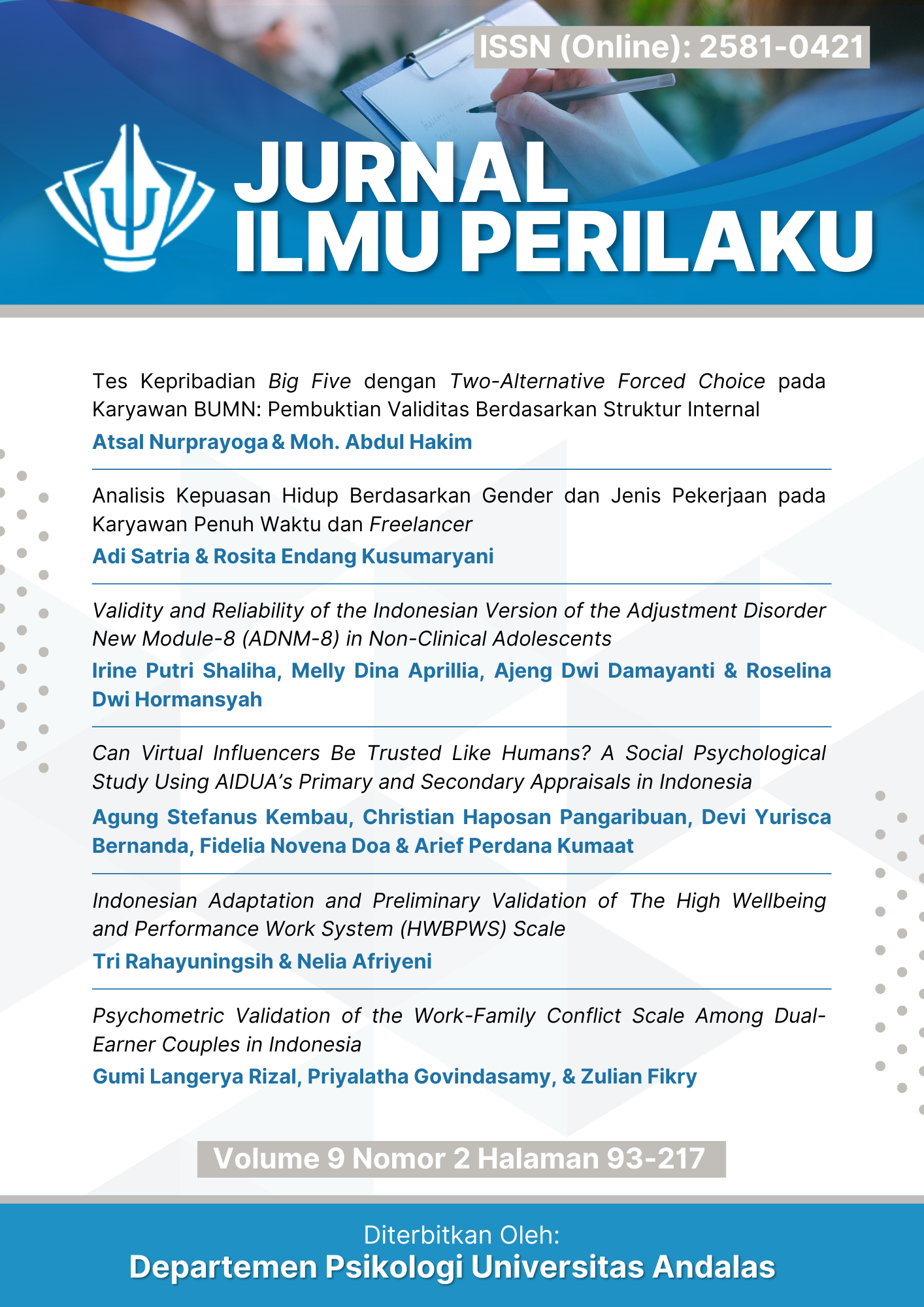
Tes Kepribadian Big Five dengan Two-Alternative Forced Choice pada Karyawan BUMN: Pembuktian Validitas Berdasarkan Struktur Internal
DOI:
https://doi.org/10.25077/jip.9.2.93-112.2025Keywords:
confirmatory factor analysis, construcy validity, big five personalityAbstract
Personality assessments help companies maintain the quality of human resources (HR) and develop potential efficiently. The use of personality assessment in Indonesia faces challenges, such as limited tools relevant to the times and the practice of buying and selling test kits. To face these challenges, state-owned company PT X developed a Big Five personality test using the two-alternative forced choice (2AFC) method. This study aims to test the construct validity of the Big Five personality test developed by BUMN PT X with a sample of BUMN employees. The data analysis technique used confirmatory factor analysis (CFA). The research subjects consisted of 3,989 employees at the Officer Position Level. The results showed that the Big Five personality test developed by BUMN PT X has good construct validity, with all dimensions having a fit model. It is shown from the overall model fit assessment (Chi-square, SRMR, RMSEA, CFI, and TLI) that it meets the expected value index. The results also show residual covariance in four dimensions (openness to experience, conscientiousness, agreeableness, and neuroticism). The findings show that the personality test tool developed shows adequate construct validity in measuring employees' Big Five personalities. This personality test will help companies make decisions when managing human resources, especially in the BUMN environment.
Downloads
References
Ahya, A., & Siaputra, I. B. (2021). Validasi Big Five Inventory-2 (BFI-2) untuk Indonesia: Belum sempurna tetapi valid dan reliabel mengukur kepribadian. Jurnal Psikologi Ulayat: Indonesian Journal of Indigenous Psychology, 9(1), 179–203 https://doi.org/10.24854/jpu458
Amin, N. F., Garancang, S., & Abunawas, K. (2023). Konsep umum populasi dan sampel dalam penelitian. Jurnal PILAR: Jurnal Kajian Islam Kontemporer, 14(1), 15–31. https://doi.org/10.24252/pilar.v14i1.10624
Brown, T. A. (2015). Confirmatory factor analysis for applied research (Edisi 2.). The Guilford Press.
Chen, S., Chen, C., Yang, J., & Yuan, J. (2017). Trait self-consciousness predicts amygdala activation and its functional brain connectivity during emotional suppression: An fMRI analysis. Scientific Reports, 7, 117. https://doi.org/10.1038/s41598-017-00073-3
Cole, D. A., Ciesla, J. A., & Steiger, J. H. (2007). The insidious effects of failing to include design-driven correlated residuals in latent-variable covariance structure analysis. Psychological Methods, 12(4), 381–398. https://doi.org/10.1037/1082-989X.12.4.381
Fauzia, F. (2012). Perbandingan sosial desirabilitas bentuk soal skala likert, semantik diferensial, dan forced-choice dalam pengukuran prosocial tendencies. Jurnal Pengukuran Psikologi dan Pendidikan Indonesia, 1(4), 263-282. https://doi.org/10.15408/jp3i.v1i4.10727
Feist, J., & Feist, G. J. (2009). Theories of personality (7th ed.). McGraw-Hill.
Graeff, T. R. (2005). Response bias. Dalam K.Kempf-Leonard (Ed.), Encyclopedia of social measurement (Vol.3, hlm. 411-418). Elsevier. https://doi.org/10.1016/B0-12-369398-5/00037-2
Graziano, W. G., & Eisenberg, N. (1997). Agreeableness: A dimension of personality. In R. Hogan, J. Johnson, & S. R. Briggs (Eds.), Handbook of personality psychology (pp. 767–793). Academic Press.
Goldberg, L. R. (1990). An alternative “description of personality”: The big five factor structure. Journal of Personality and Social Psychology, 59(6), 1216-1229. https://doi.org/10.1037/0022-3514.59.6.1216
Goldberg, L. R. (1981). Language and individual differences: The search for universals in personality lexicons. In L. Wheeler (Ed.), Review of personality and social psychology (Vol. 2, pp. 141–165). Sage.
Hair, J. F., Black, W. C., Babin, B. J., & Anderson, R. E. (2019). Multivariate data analysis (8th ed.). Cengage Learning.
Hakim, M. A., Kusuma, N. K. L., Prasetyani, R. N. N., Pradana, R. G., Anggrani, F. K., Saniatuzzulfa, R., et al. (2024). Laporan final pekerjaan: Pengembangan alat ukur dan sistem pendukung asesmen kompetensi PT X.
Kementerian Badan Usaha Milik Negara Republik Indonesia. (2022). Perubahan atas Peraturan Menteri Badan Usaha Milik Negara Nomor PER-11/MBU/07/2021 tentang persyaratan, tata cara pengangkatan, dan pemberhentian anggota direksi badan usaha milik negara (Nomor PER-7-/MBU/09/2022). Kementerian BUMN. https://peraturan.bpk.go.id/Details/232832/permen-bumn-no-per-7mbu092022-tahun-2022
Lounsbury, J. W., Park, S. H., Sundstrom, E., Williamson, J. M., & Pemberton, A. E. (2004). Personality, career satisfaction, and life satisfaction: Test of a directional model. Journal of Career Assessment, 12(4), 395–406. https://doi.org/10.1177/1069072704266658
Marlina, N. (2017). Pengaruh kepribadian dan hubungan antar karyawan terhadap keterlibatan kerja karyawan pada BUMN PT TASPEN (Persero) Cabang Pontianak dan PT Jasa Raharja (Persero) Cabang Pontianak. Jurnal Manajemen Update, 6(2). https://jurnal.untan.ac.id/index.php/ejmfe/article/view/20662
McCrae, R.R., & John, O.P. (1992). An introduction to the Five-Factor Model and its applications. Journal of Personality, 60, 175-215. https://doi.org/10.1111/j.1467-6494.1992.tb00970.x
Moon, H. (2001). The two faces of conscientiousness : Duty and achievement striving in escalation of commitment dilemmas. Journal of applied psychology, 86(3), 533-540. https://doi.org/10.1037//0021-9010.86.3.533
Nazir. (2005). Metode Penelitian. Jakarta: Ghalia Indonesia.
Ones, D. S. (2005). Personality at work :Raising awareness and correcting misconceptions. Human Performance, 18(4), 389-404. https://doi.org/10.1207/s15327043hup1804_5
Piedmont, R. L. (1998). The revised NEO Personality Inventory: Clinical and research applications. Plenum Press.
Rahmatullah, B. (2023). Analisis pelanggaran kode etik psikologi (Studi Kasus Putusan Nomor 463/Pdt.G/2013/PN.JKT.SEL). Justices : Journal of Law, 2(2), 72-83. https://doi.org/10.58355/justices.v2i2.72
Riyadiningsih, H., & Sundari, S. (2014). Tipe kepribadian karyawan dalam meningkatkan kinerja organisasi. Dalam Proceedings of Seminar Nasional dan Call for Paper (Sancal 2014) : Research Methods and Organizational Studies (pp. 389-396). Universitas Wijayakusuma Purwokerto.
Rothman, S., & Coetzer, E. P. (2003). The Big Five personality dimensions and job performance. SA Journal of Industrial Psychology, 29(1), 68-74. https://doi.org/10.4102/sajip.v29i1.88
Sugiyono. (2005). Memahami penelitian kualitatif. Alfabeta.
Suwartono, C. (2016). Alat tes psikologi konteks Indonesia : Tantangan psikologi di era MEA. Jurnal Psikologi Ulayat, 3(1), 1-6. https://doi.org/10.24854/jpu37
Swami, V., & Furnham, A. (2014). Personality and aesthetic experiences. In P. P. L. Tinio & J. K. Smith (Eds.), The Cambridge Handbook of the Psychology of Aesthetics and the Arts (pp. 540–561). chapter, Cambridge: Cambridge University Press.
Wang, J., & Wang, X. (2019). Structural equation modeling: Applications using Mplus (2nd ed.). Wiley.
Wicaksana, S. A., Novasari, E. P., & Octafiany, T. (2019). Uji validitas dan reliabilitas NEO-PI-R versi Humanika Consulting. Jurnal Psikologi, Vol. 3(No. 1), 1–15. https://doi.org/10.13140/RG.2.2.27814.98881
Downloads
Published
How to Cite
Issue
Section
License
Copyright (c) 2026 Atsal Nurprayoga, Moh. Abdul Hakim

This work is licensed under a Creative Commons Attribution-NonCommercial-ShareAlike 4.0 International License.
The non-commercial use of the article is governed by the Creative Commons Attribution license as currently displayed on Creative Commons Attribution-NonCommercial-ShareAlike 4.0 International License.
JIP's spirit is to disseminate articles published are as free as possible. Under the Creative Commons license, JIP permits users to copy, distribute, display, and perform the work for non-commercial purposes only. Users will also need to attribute authors and JIP on distributing works in the journal.
Please find the rights and licenses in Jurnal Ilmu Perilaku (JIP).
- License
The non-commercial use of the article will be governed by the Creative Commons Attribution license as currently displayed on Creative Commons Attribution-NonCommercial-ShareAlike 4.0 International License.
- Author’s Warranties
The author warrants that the article is original, written by stated author(s), has not been published before, contains no unlawful statements, does not infringe the rights of others, is subject to copyright that is vested exclusively in the author and free of any third party rights, and that any necessary written permissions to quote from other sources have been obtained by the author(s).
- User Rights
JIP's spirit is to disseminate articles published are as free as possible. Under the Creative Commons license, JIP permits users to copy, distribute, display, and perform the work for non-commercial purposes only. Users will also need to attribute authors and JIP on distributing works in the journal.
- Rights of Authors
Authors retain the following rights:
- Copyright, and other proprietary rights relating to the article, such as patent rights,
- The right to use the substance of the article in future own works, including lectures and books,
- The right to reproduce the article for own purposes, provided the copies are not offered for sale,
- The right to self-archive the article.
- Co-Authorship
If the article was jointly prepared by other authors, the signatory of this form warrants that he/she has been authorized by all co-authors to sign this agreement on their behalf, and agrees to inform his/her co-authors of the terms of this agreement.
- Termination
This agreement can be terminated by the author or JIP upon two months’ notice where the other party has materially breached this agreement and failed to remedy such breach within a month of being given the terminating party’s notice requesting such breach to be remedied. No breach or violation of this agreement will cause this agreement or any license granted in it to terminate automatically or affect the definition of JIP.
- Royalties
This agreement entitles the author to no royalties or other fees. To such extent as legally permissible, the author waives his or her right to collect royalties relative to the article in respect of any use of the article by JIP or its sublicensee.
- Miscellaneous
JIP will publish the article (or have it published) in the journal if the article’s editorial process is successfully completed and JIP or its sublicensee has become obligated to have the article published. JIP may conform the article to a style of punctuation, spelling, capitalization, referencing and usage that it deems appropriate. The author acknowledges that the article may be published so that it will be publicly accessible and such access will be free of charge for the readers.