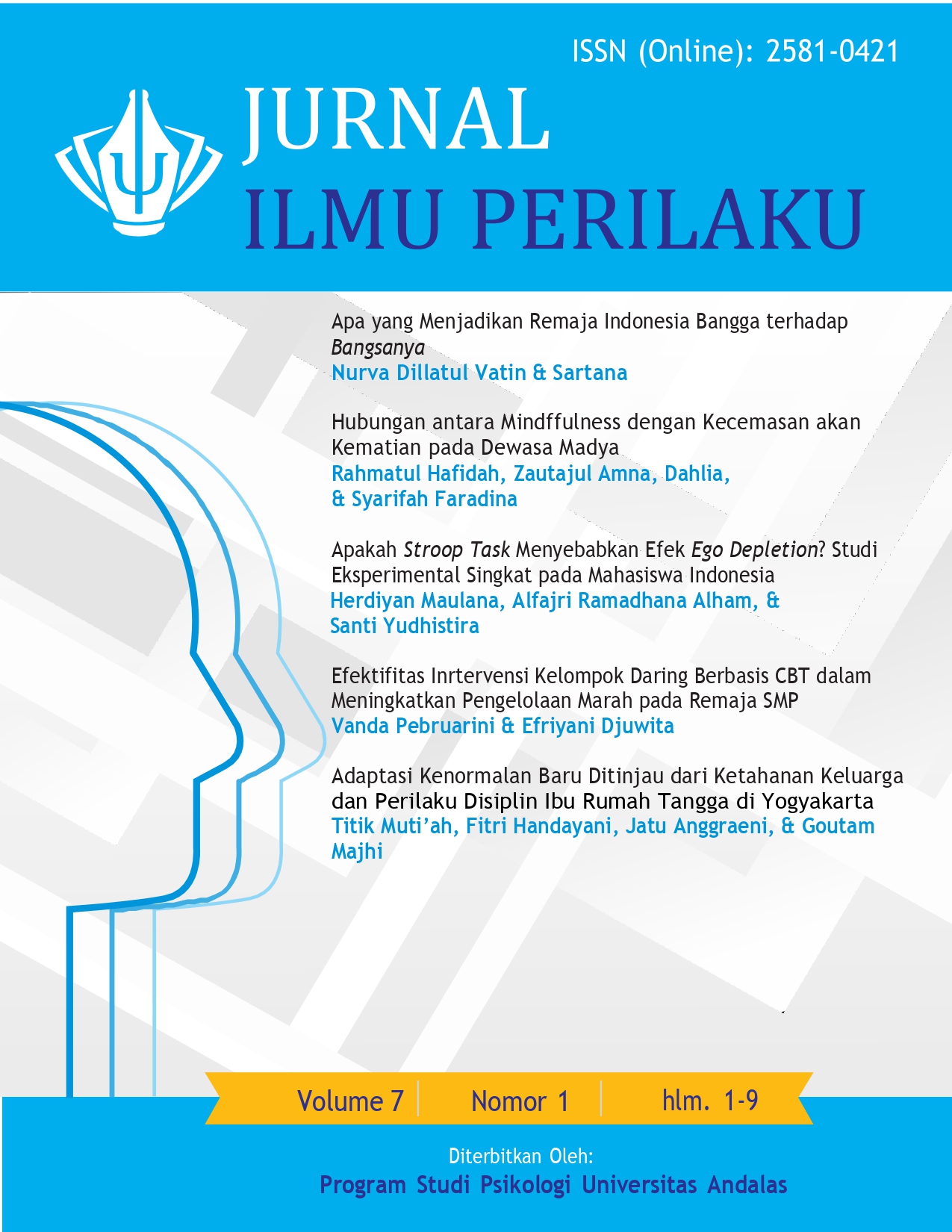
Efektivitas Intervensi Kelompok Daring Berbasis CBT dalam Meningkatkan Pengelolaan Marah pada Remaja SMP
Effectiveness of Online Group Cognitive Behavior Therapy (CBT) to Improve Anger Control in Junior High School Students
DOI:
https://doi.org/10.25077/jip.7.1.61-79.2023Keywords:
anger management, CBT, kemarahan, remajaAbstract
Anger management is known to be challenging for adolescents because they often lack experience or coping skills to cope with complex emotions. Intense anger or unassertive anger expression may inflict severe problems on their social, physical, and mental health. This study aims to assess the effectiveness of Cognitive Behavior Therapy (CBT) based online intervention in improving anger management skills in four junior high school students. This mixed method research with the qualitative and quantitative results. The participants of this study are 12 – 15 years old with a high level of anger. The result showed that all participant level of anger decreased significantly, also their anger expression. Participants' anger management also increased significantly compare to the post-test and follow-up test (1-month interval). The qualitative result showed that all participants expressed that their anger management improved after the session. In conclusion, this online CBT proved to be effective in reducing adolescent anger levels and expression and increasing their anger management ability.
Downloads
References
American Psychological Association. (2012). Anger: How to Recognize and Deal with a Common Emotion. APA. https://www.apa.org/news/press/releases/2012/05/anger
American Psychological Association. (2019). Anger More Harmful to Health of Older Adults Than Sadness. APA. https://www.apa.org/news/press/releases/2019/05/anger-harmful-older-adults
American Psychological Association. (2022). Control anger before it controls you. APA. https://www.apa.org/topics/anger/control
Baker, G.S. (2019). Emotional Intelligence How to Control Your Emotion: Anger Management Copyright.
Belițoiu, R.R. (2019). The Relationship between Parental Styles, Anger Management, and Cognitive-Emotional Coping Mechanisms in Adolescents. Journal of: Experiential Psychotherapy, 22(4) (88), 17—24.
Beames, J. R., O'Dean, S. M., Grisham, J. R., Moulds, M. L., & Denson, T. F. (2019). Anger regulation in interpersonal contexts: Anger experience, aggressive behavior, and cardiovascular reactivity. Journal of Social and Personal Relationships, 36(5), 1441–1458. https://doi:10.1177/0265407518819295 10.1177/026540751881929
Carolina, C. & Tjakrawiralaksana, M. A. (2021). “Efektivitas intervensi teen anger management and education dalam mengatasi masalah kemarahan dan agresivitas pada remaja perempuanâ€, Jurnal Ilmiah Psikologi Terapan, 9(2), 200–210. doi: https://10.22219/jipt.v9i2.14441.
Chin, Lee & Ahmad, Nor. (2017). Effect of cognitive behavioral therapy (CBT) anger management module for adolescents. International Journal of Guidance and Counselling, 3(2), 68--78.
Cumming, M. M., Poling, D., & Smith, S. W. (2021). Validation of the Anger Expression Scale for Children with Fourth and Fifth Graders: Implications for Identifying Students at Risk for Behavior Problems. Assessment, 28(5), 1418–1433. https://doi.org/10.1177/1073191119897119
Davies, L. (2016), "Are young fathers “hard to reach� Understanding the importance of relationship building and service sustainability". Journal of Children's Services, 11(4), 317—329. https://doi.org/10.1108/JCS-03-2016-0007
Desra, N. (2019). Respon Siswa dalam Menungkapkan Emosi Marah di SMP dan Implikasinya terhadap Layanan Bimbingan dan Konseling [Unpublished thesis]. Universitas Pendidikan Padang.
Gilihan, S. (2018). Cognitive Behavior Therapy Made Simple. Emeryville: Althea Press.
Hasmarlin, H. & Hirmaningsih. (2019). Regulasi Emosi Pada Anak Laki-laki dan Perempuan. Marwah. Jurnal Perempuan, Agama dan Jender, 18(1), 87--95.
Lestari, A., & Marjo, H. K. (2021). Efektifitas Teknik Anger Management dalam Mengelola Emosi Marah yang dilakukan melalui e-counseling di SMP Islam Al Azhar 12 Rawamangun. Insight: Jurnal Bimbingan dan Konseling, 10(1), 14--22. DOI: https://doi.org/10.21009/INSIGHT.101.03
Marotz, Lynn R., Allen, K. Eileen. (2016). Developmental Profiles: Pre-Birth Through Adolescence (8th Ed.). Cengage Learning.
Martin, R. C. (2020). Including Maladaptive Anger in Psychology Courses. Teaching of Psychology, 47(1), 102–107. https://doi.org/10.1177/0098628319889540
Morrison, J., & Kathryn F. (2016). Interviewing Children and Adolescents 2 edition: Skills and Strategies for Effective DSM-5 Diagnosis. London: The Guilford Press.
Stallard, P. (2005). A clinician’s guide to Think Good Feel Good: the use of CBT with children and young people. Chichester: John Wiley.
Steele‚ R.G.‚ Legerski‚ Nelson‚ T.D.‚ & Phipps‚ S. (2009). The Anger Expression Scale for Children: Initial validation among healthy children and children with cancer. Journal of pediatric psychology, 34(1), 51—62.
Takebe, M., Takahashi, F., & Sato, H. (2017). The Effects of Anger Rumination and Cognitive Reappraisal on Anger-In and Anger-Control. Cognitive Therapy and Research, 41(4), 654–661. doi:10.1007/s10608-017-9837-x 10.1007/s10608-017-9837-x
Tsai. (2019). Gaining Control: Anger Management Group for Adolescents [Graduate Project]. California State University.
Vannucci, A., Ohannessian, C. M., Flannery, K. M., De Los Reyes, A., & Liu, S. (2018). Associations between friend conflict and affective states in the daily lives of adolescents. Journal of Adolescence, 65, 155–166. doi:10.1016/j.adolescence.2018.03.014
Downloads
Published
How to Cite
Issue
Section
License
The non-commercial use of the article is governed by the Creative Commons Attribution license as currently displayed on Creative Commons Attribution-NonCommercial-ShareAlike 4.0 International License.
JIP's spirit is to disseminate articles published are as free as possible. Under the Creative Commons license, JIP permits users to copy, distribute, display, and perform the work for non-commercial purposes only. Users will also need to attribute authors and JIP on distributing works in the journal.
Please find the rights and licenses in Jurnal Ilmu Perilaku (JIP).
- License
The non-commercial use of the article will be governed by the Creative Commons Attribution license as currently displayed on Creative Commons Attribution-NonCommercial-ShareAlike 4.0 International License.
- Author’s Warranties
The author warrants that the article is original, written by stated author(s), has not been published before, contains no unlawful statements, does not infringe the rights of others, is subject to copyright that is vested exclusively in the author and free of any third party rights, and that any necessary written permissions to quote from other sources have been obtained by the author(s).
- User Rights
JIP's spirit is to disseminate articles published are as free as possible. Under the Creative Commons license, JIP permits users to copy, distribute, display, and perform the work for non-commercial purposes only. Users will also need to attribute authors and JIP on distributing works in the journal.
- Rights of Authors
Authors retain the following rights:
- Copyright, and other proprietary rights relating to the article, such as patent rights,
- The right to use the substance of the article in future own works, including lectures and books,
- The right to reproduce the article for own purposes, provided the copies are not offered for sale,
- The right to self-archive the article.
- Co-Authorship
If the article was jointly prepared by other authors, the signatory of this form warrants that he/she has been authorized by all co-authors to sign this agreement on their behalf, and agrees to inform his/her co-authors of the terms of this agreement.
- Termination
This agreement can be terminated by the author or JIP upon two months’ notice where the other party has materially breached this agreement and failed to remedy such breach within a month of being given the terminating party’s notice requesting such breach to be remedied. No breach or violation of this agreement will cause this agreement or any license granted in it to terminate automatically or affect the definition of JIP.
- Royalties
This agreement entitles the author to no royalties or other fees. To such extent as legally permissible, the author waives his or her right to collect royalties relative to the article in respect of any use of the article by JIP or its sublicensee.
- Miscellaneous
JIP will publish the article (or have it published) in the journal if the article’s editorial process is successfully completed and JIP or its sublicensee has become obligated to have the article published. JIP may conform the article to a style of punctuation, spelling, capitalization, referencing and usage that it deems appropriate. The author acknowledges that the article may be published so that it will be publicly accessible and such access will be free of charge for the readers.